Anna Atkins
How I came across her
Through a calendar. On optimistic.day, her name appeared in a text beside a thought by Georg Christoph Lichtenberg about doing something new and seeing something new: a woman using a newly invented process for something it had not been devised for. I didn’t know her images. When I looked at them, first came the blue, then the fine branching of the algae, and finally the work itself: the paper’s edge, the handwritten label, small differences from sheet to sheet.
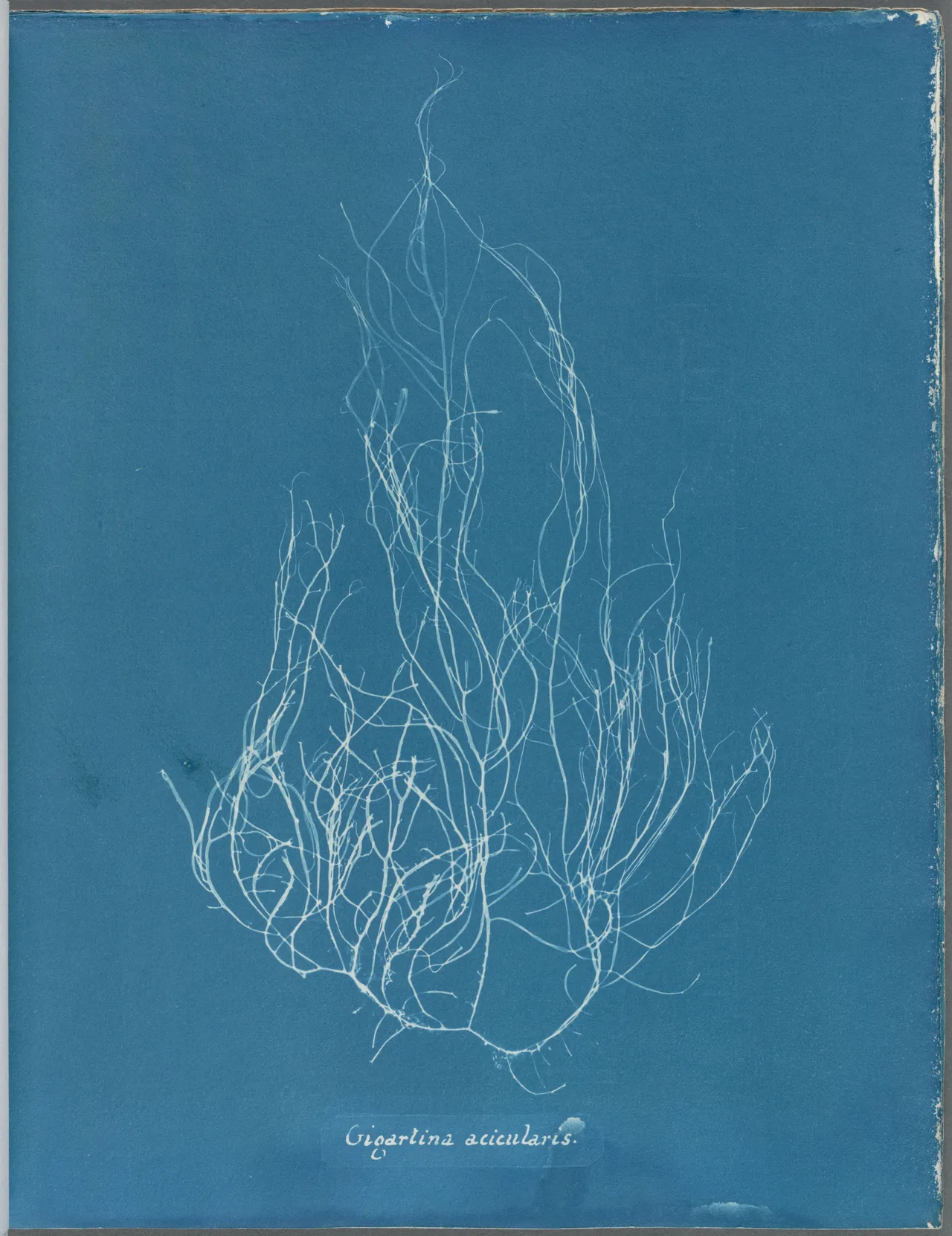
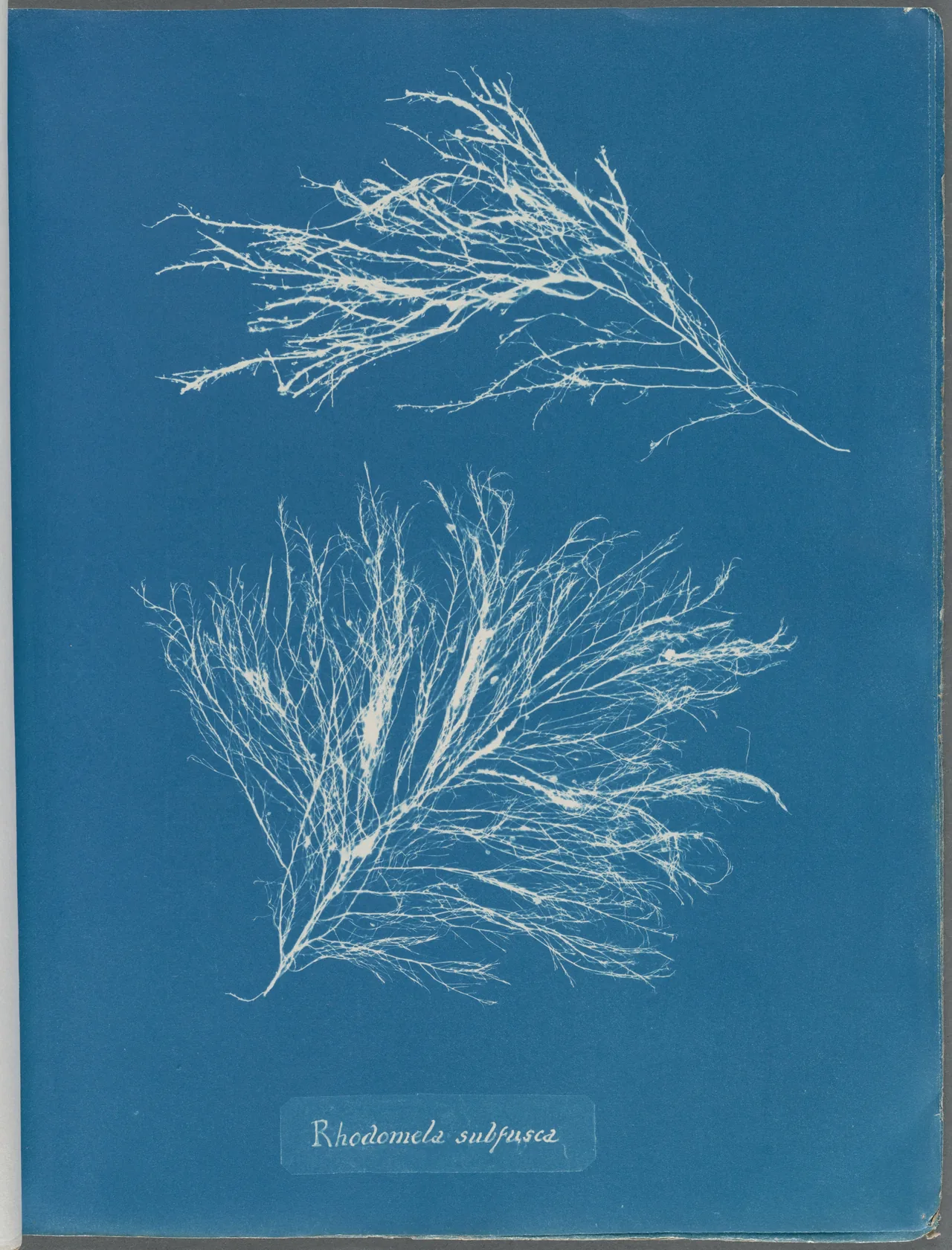
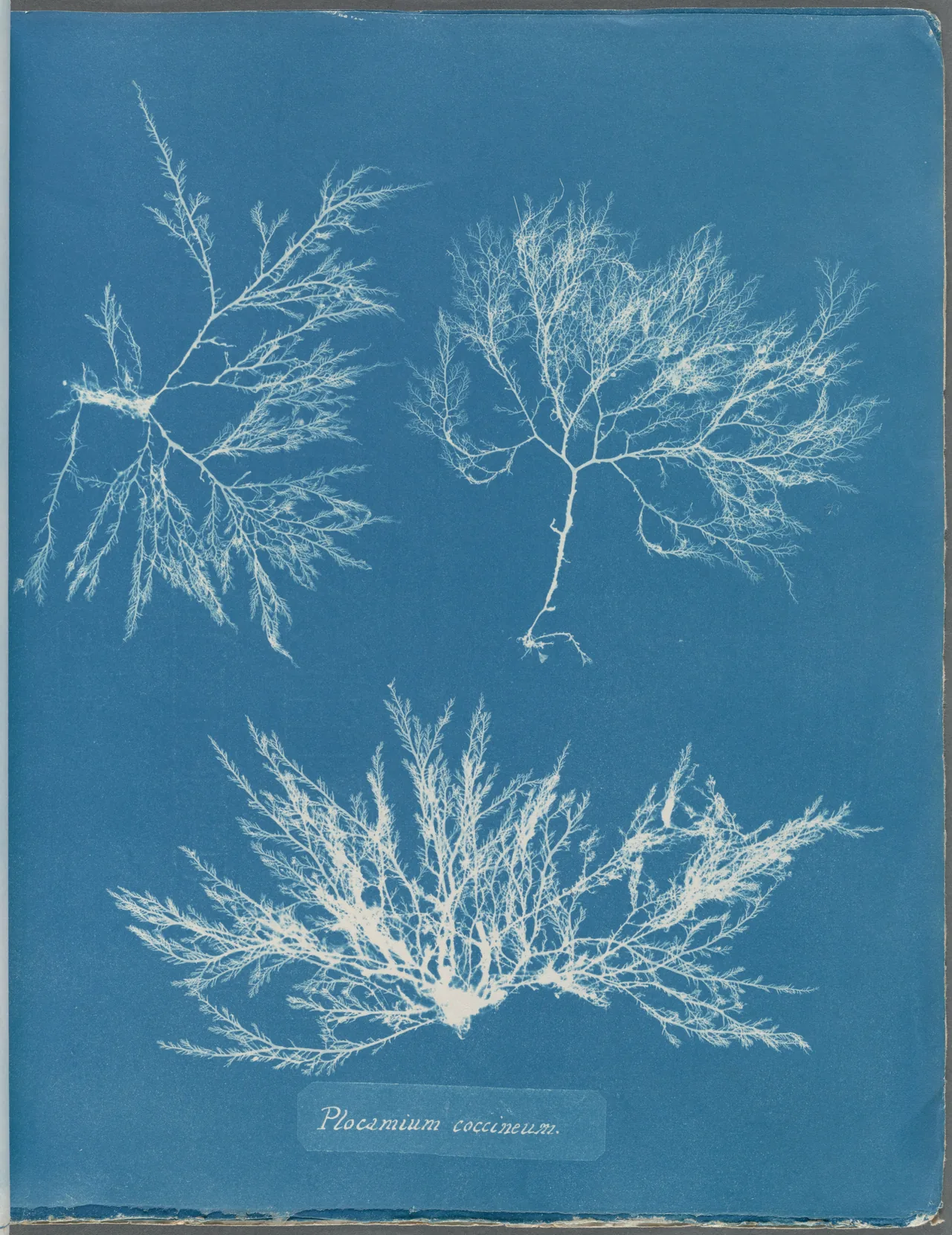
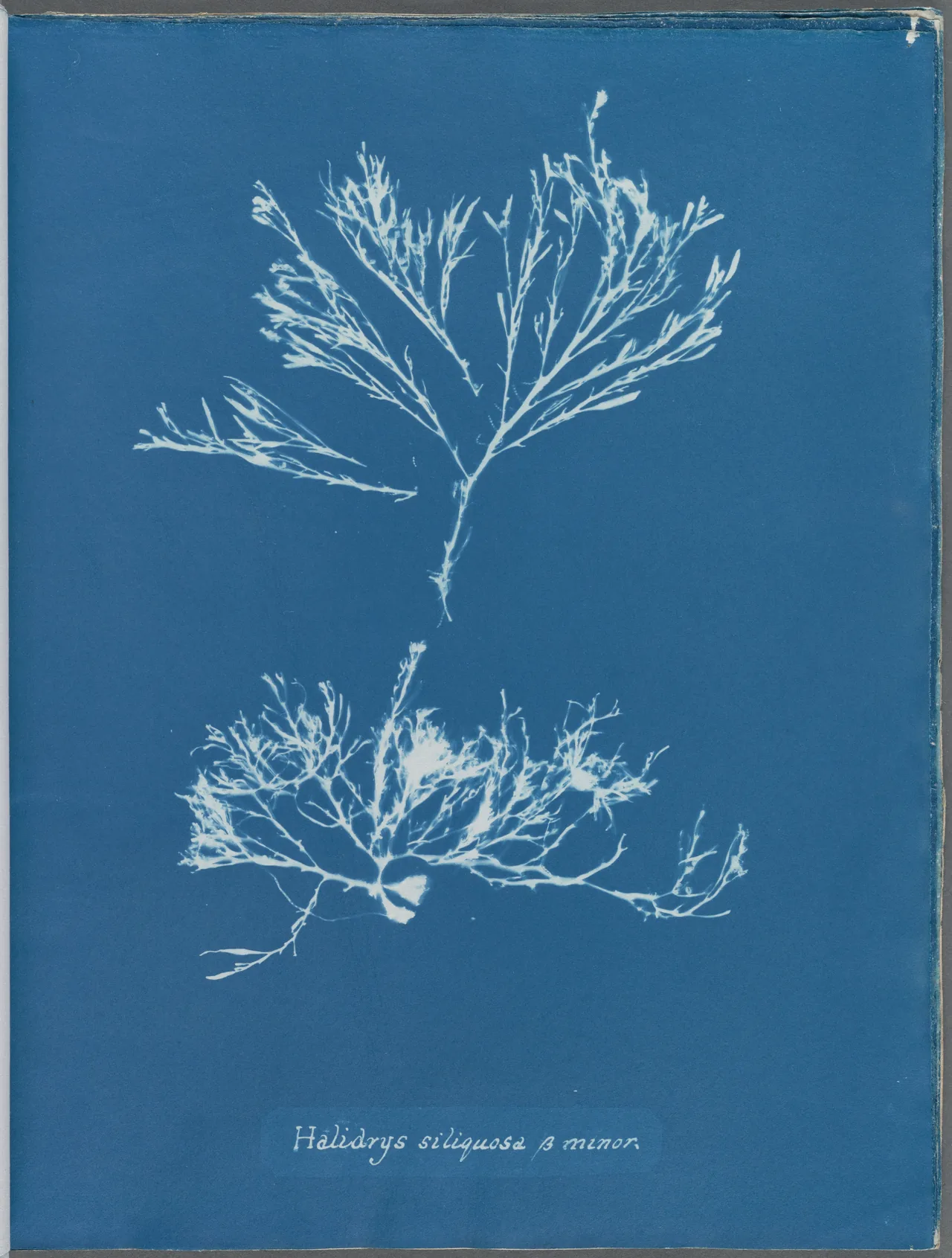
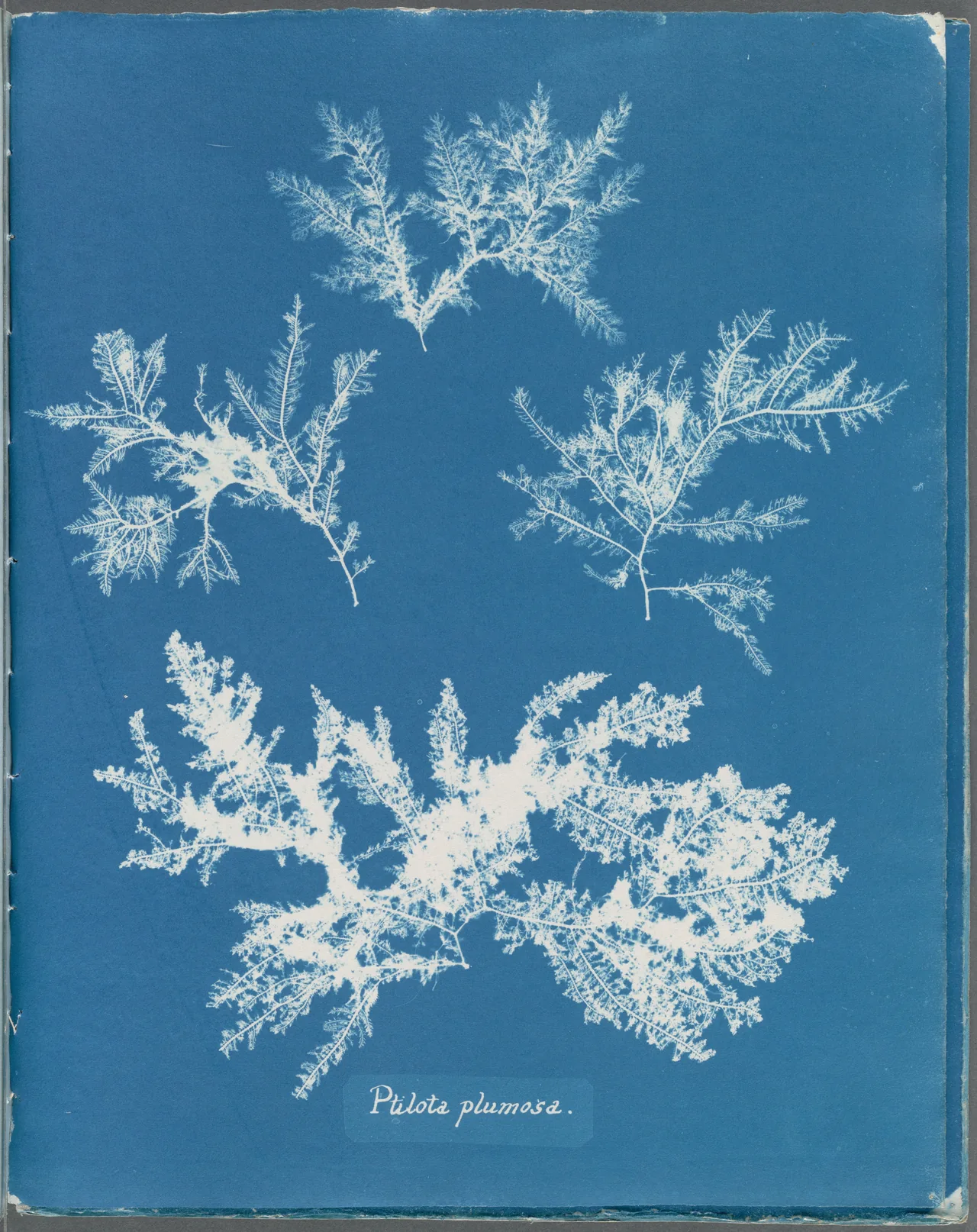
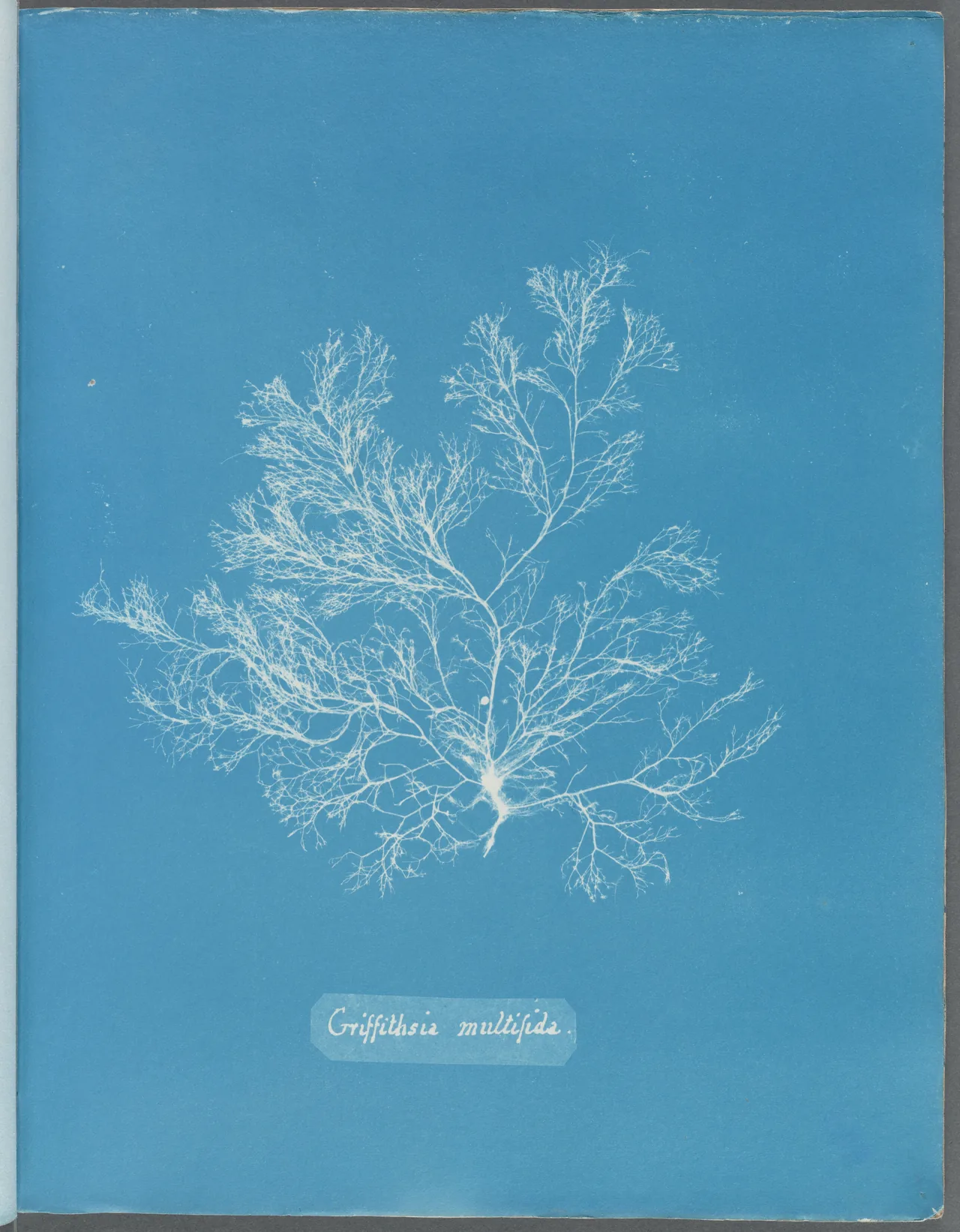
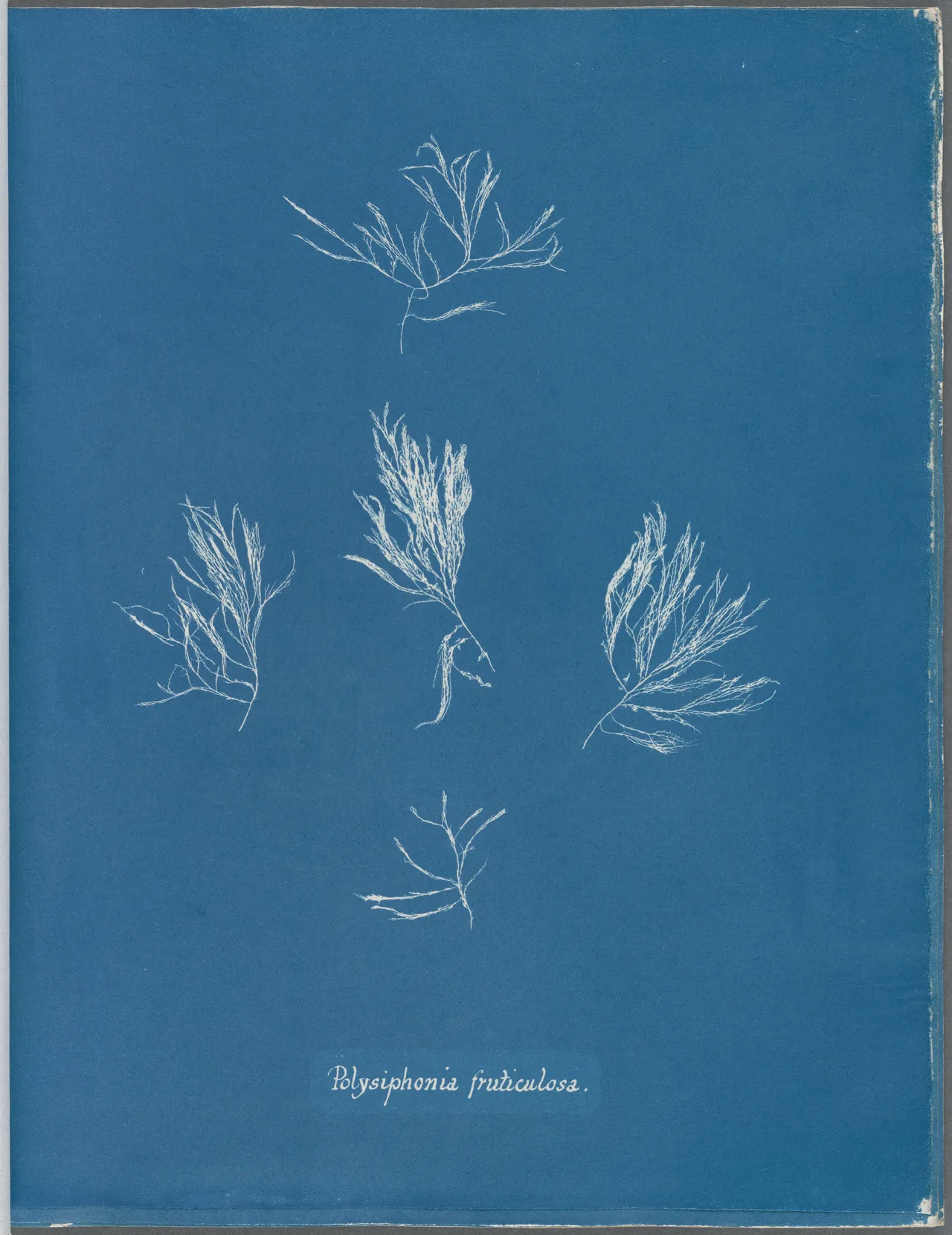
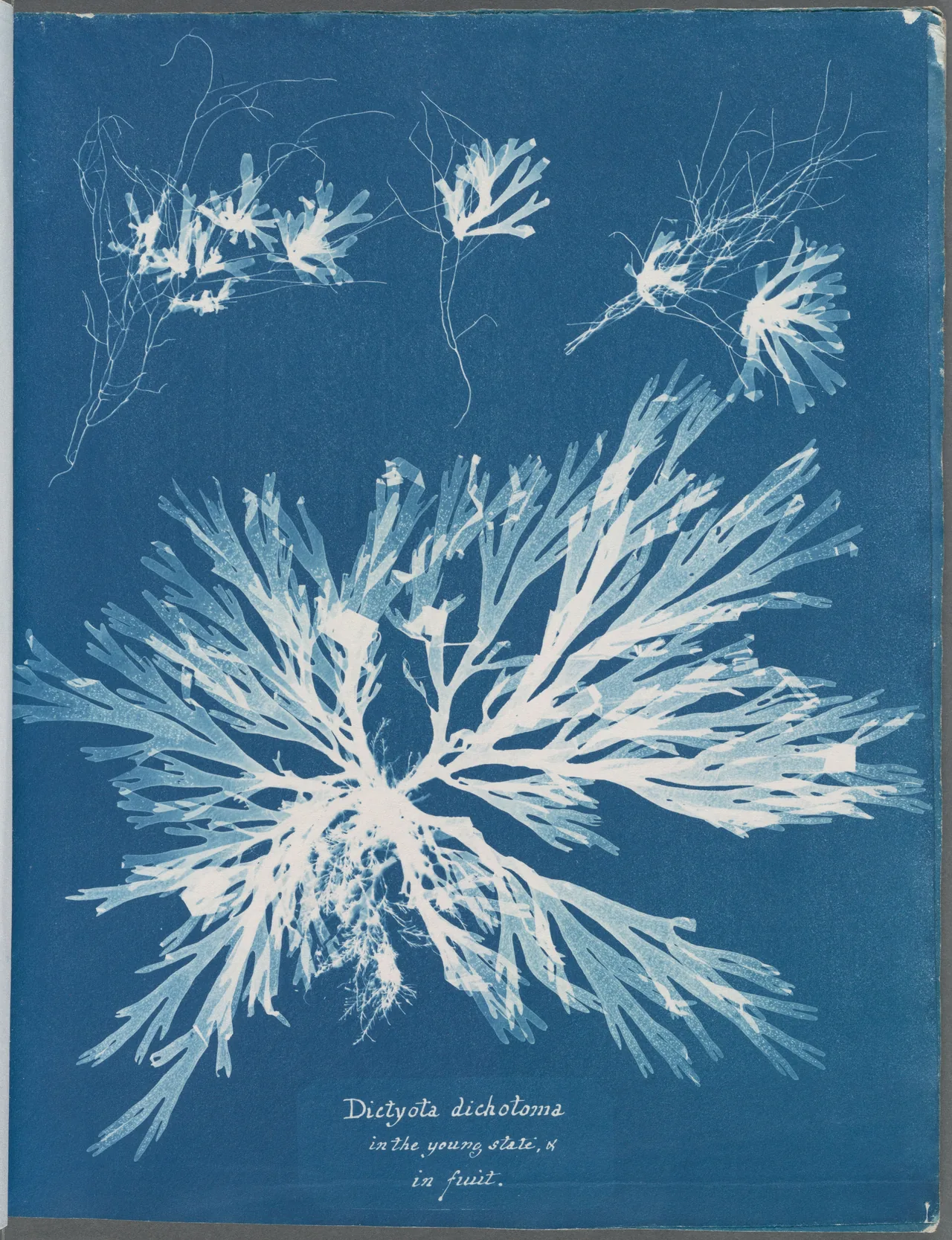
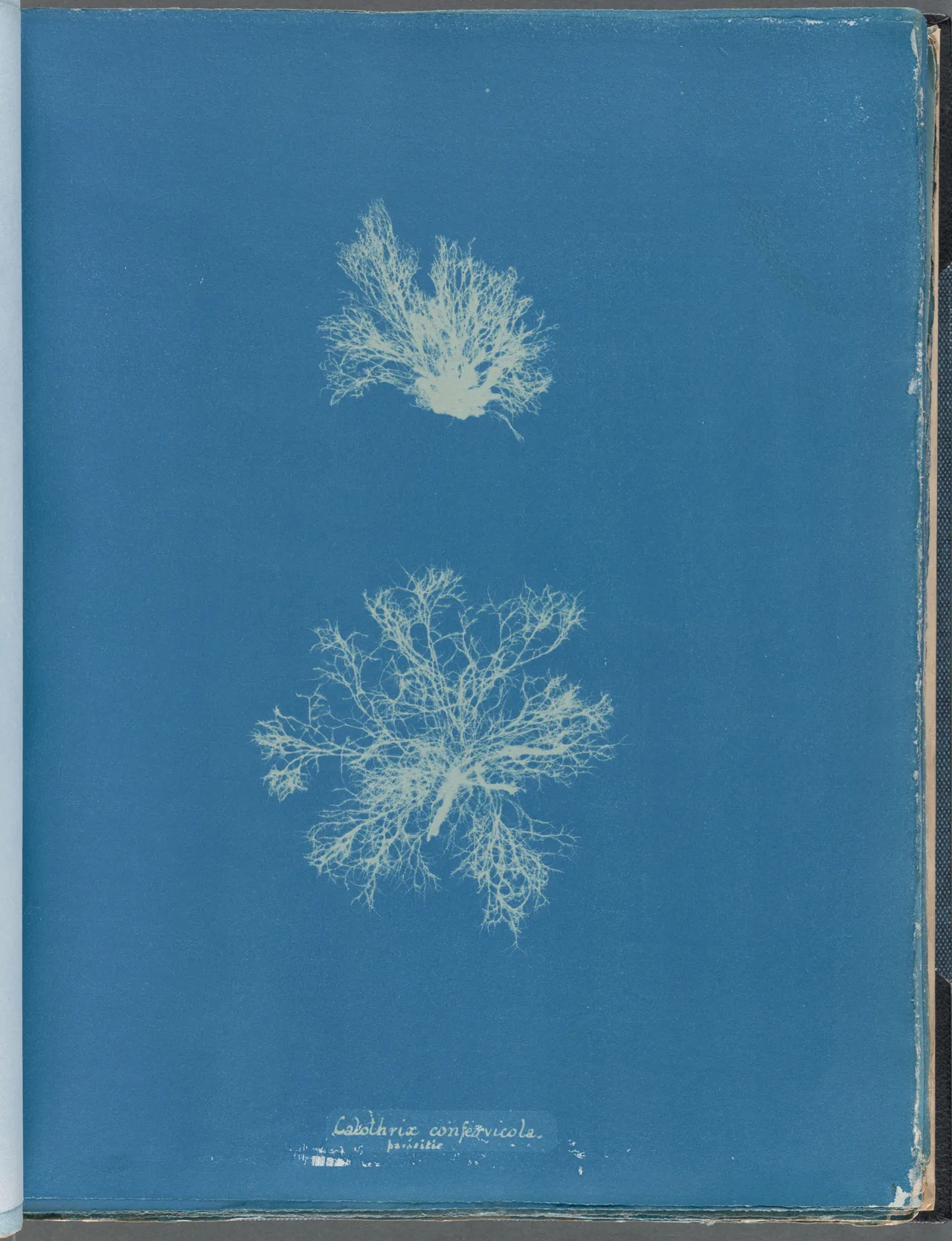
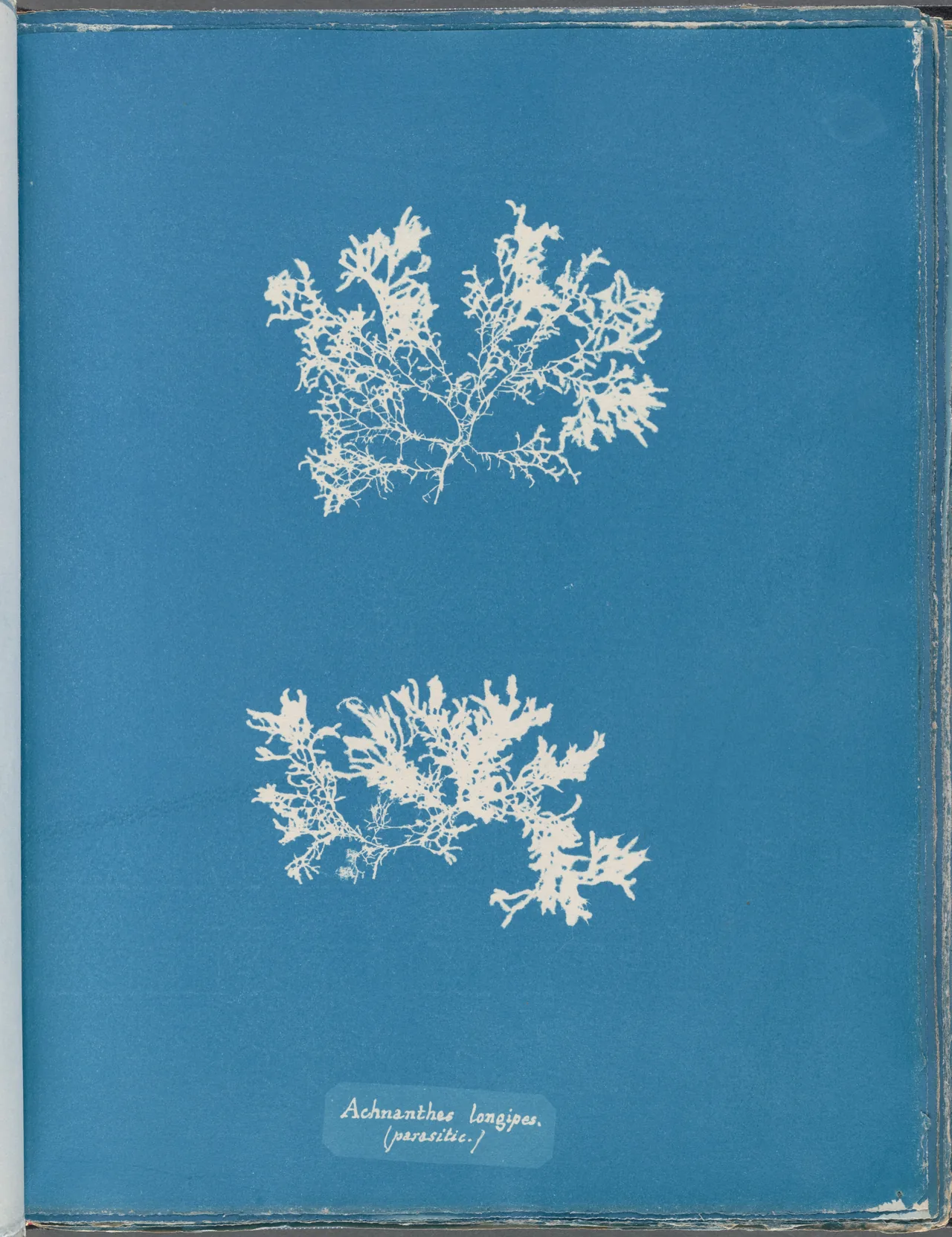
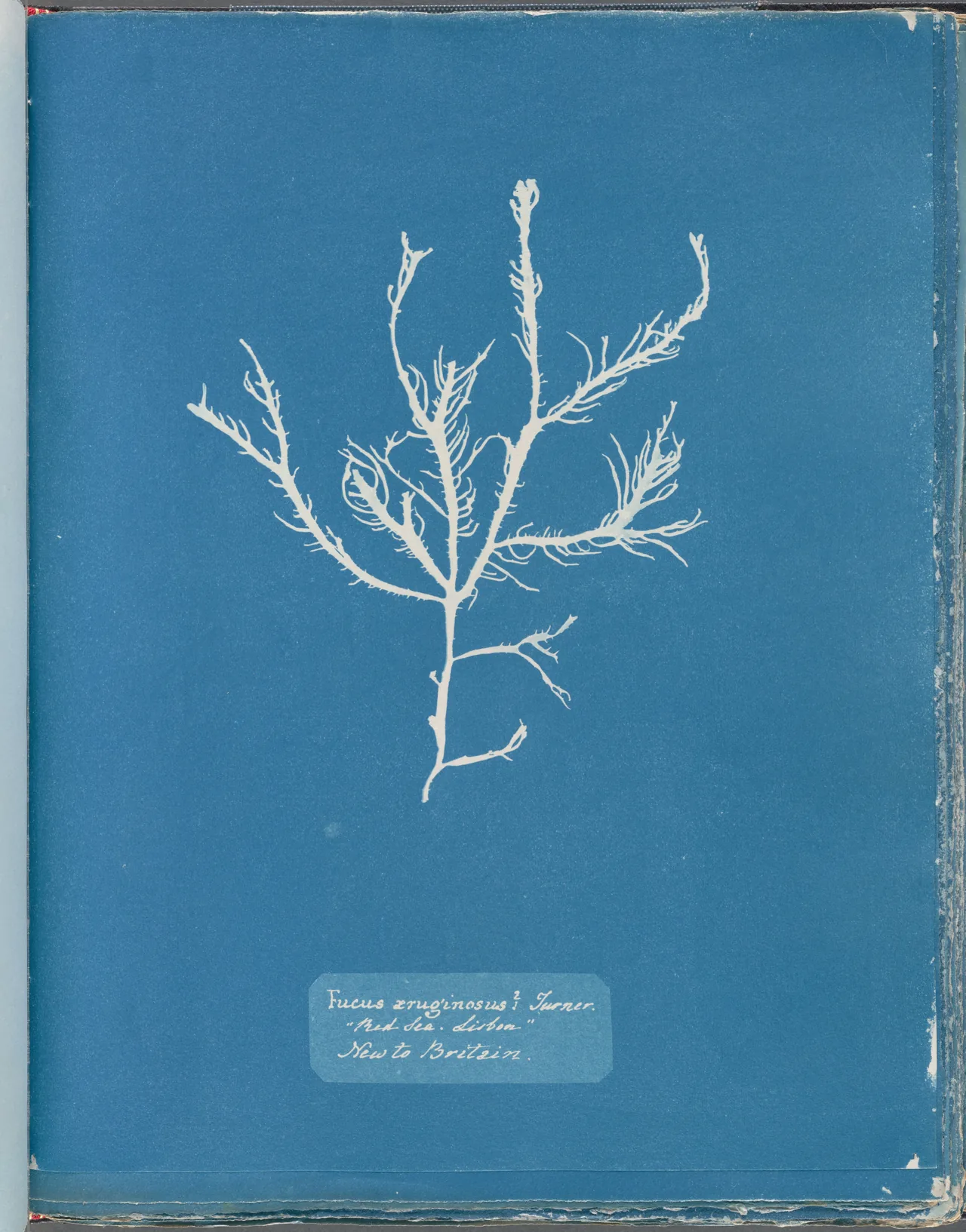
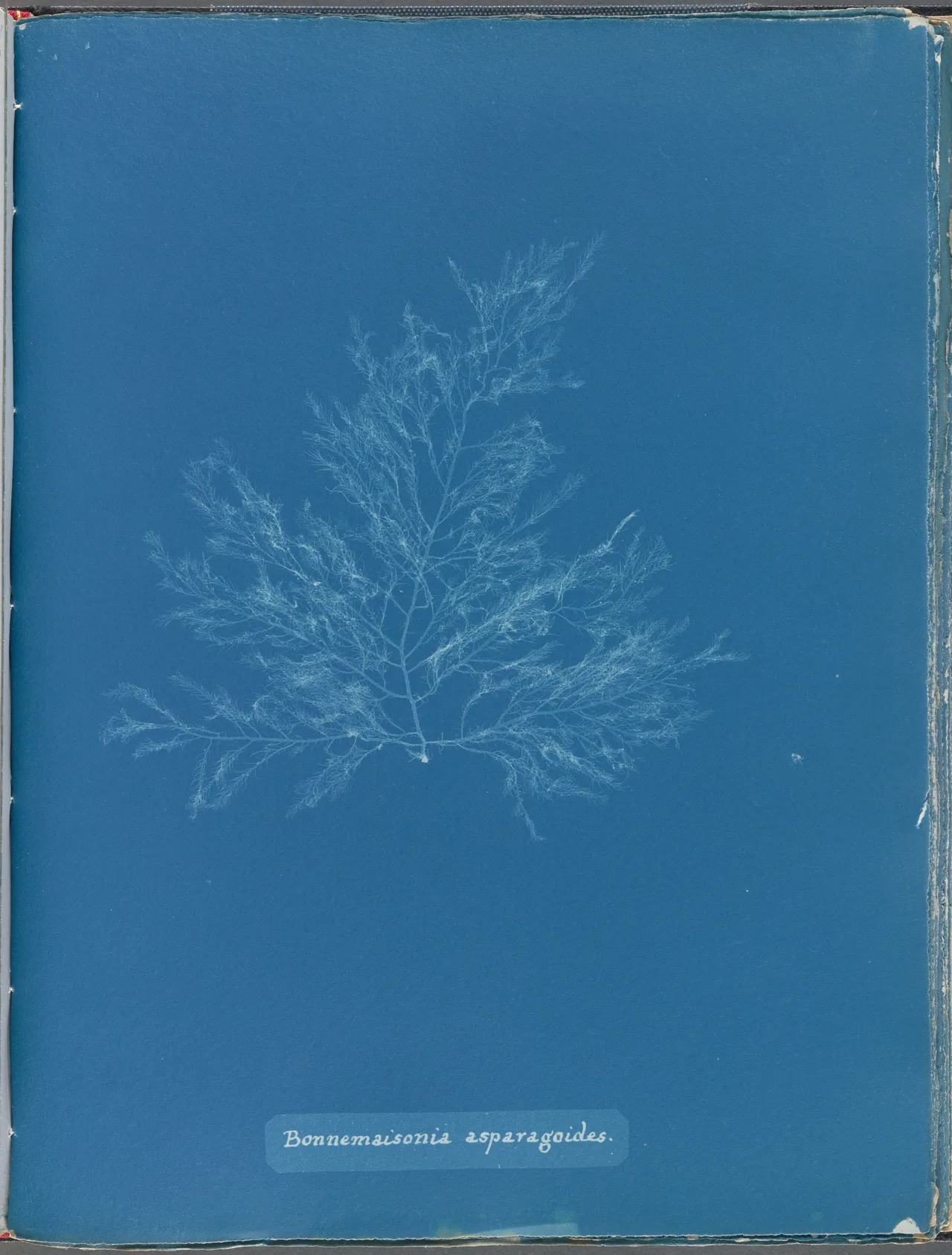
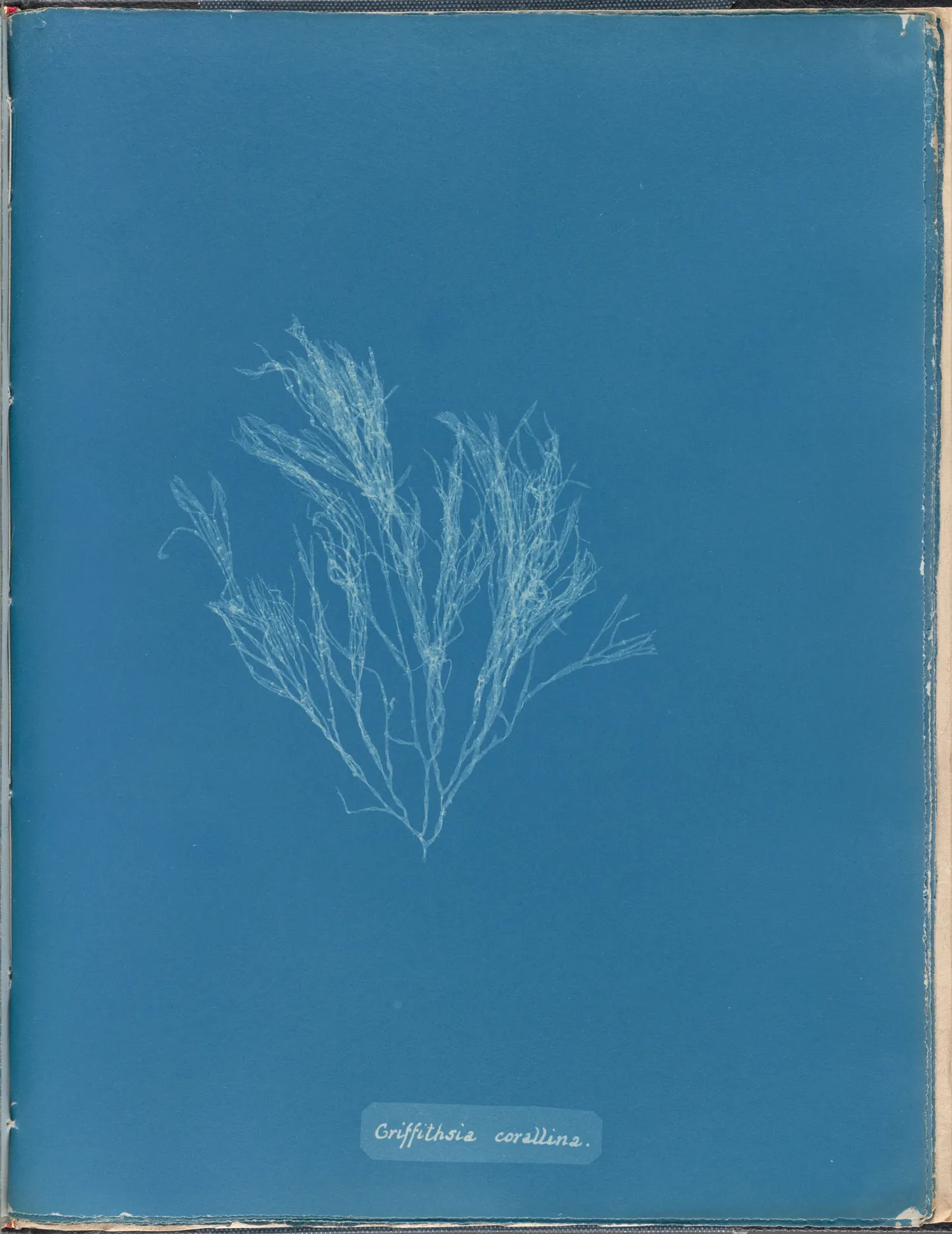
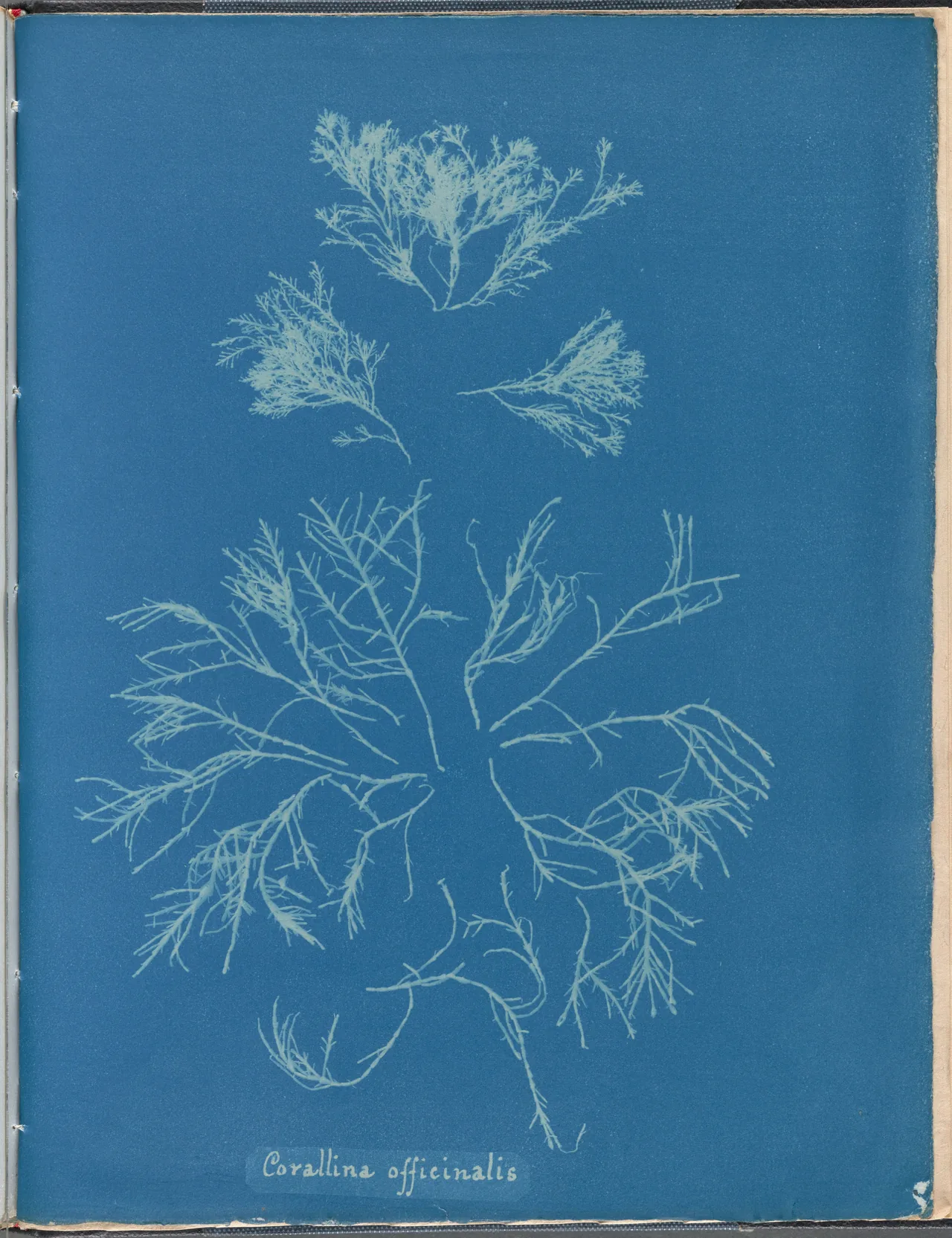
Anna Atkins wanted to show algae more accurately than a drawing could. She had three things at hand that no one else had brought together, and it is this combination that keeps me interested in her: a botanist’s knowledge of what a specimen needs to show, an illustrator’s experience of how a form sits on paper, and a process barely a year old that allowed the plant to leave its own trace. In October 1843 she sent out the first instalment of a book whose plates had been exposed by the sun: the first book with photographic illustrations. These plates now accompany this site as what they are, objects from 1843 with a history of their own.
Background and education
Anna Children was born on 16 March 1799 in Tonbridge, Kent. Her mother never recovered from childbirth and died the following year. She was raised by her father, John George Children, a chemist and zoologist, secretary of the Royal Society and, from 1822, a member of staff at the British Museum, where he helped look after the natural history collections and later headed the zoological department. In his house, collecting, arranging and looking closely were as much a part of the day as eating.
In her early twenties, she drew 256 shells for him. Children was translating Lamarck’s work on shells into English, and the title of Genera of Shells, published between 1822 and 1824, credits her: “with plates from original drawings by Miss Anna Children”. Long before photography, then, she had learned to depict a form so that someone else could distinguish it from the next.
In 1825 she married John Pelly Atkins. She continued collecting, pressed plants, built a herbarium and exchanged specimens with botanists. Botany was one of the few branches of science a woman of her time could enter, and through her father she knew the men who were just learning to draw with light.
Cyanotype and the book of 1843
William Henry Harvey’s Manual of the British Algae appeared in 1841, the first systematic survey of British algae, without a single illustration. Anyone trying to identify a species had Harvey’s description and nothing else, and the small, finely branched species were particularly difficult to render reliably in pencil. Atkins said so herself in the preface to her book:
“The difficulty of making accurate drawings of objects as minute as many of the Algae and Confervae, has induced me to avail myself of Sir John Herschel's beautiful process of Cyanotype, to obtain impressions of the plants themselves.”
Both things she needed came from her father’s circle of acquaintances. Since 1839, William Henry Fox Talbot had been placing objects directly on light-sensitive paper and calling the result “photogenic drawing”. John Herschel, a family friend, introduced cyanotype in 1842, a process based on iron salts, cheaper and simpler than anything using silver. Atkins took Talbot’s image without a camera and Herschel’s chemistry and put her algae between them.
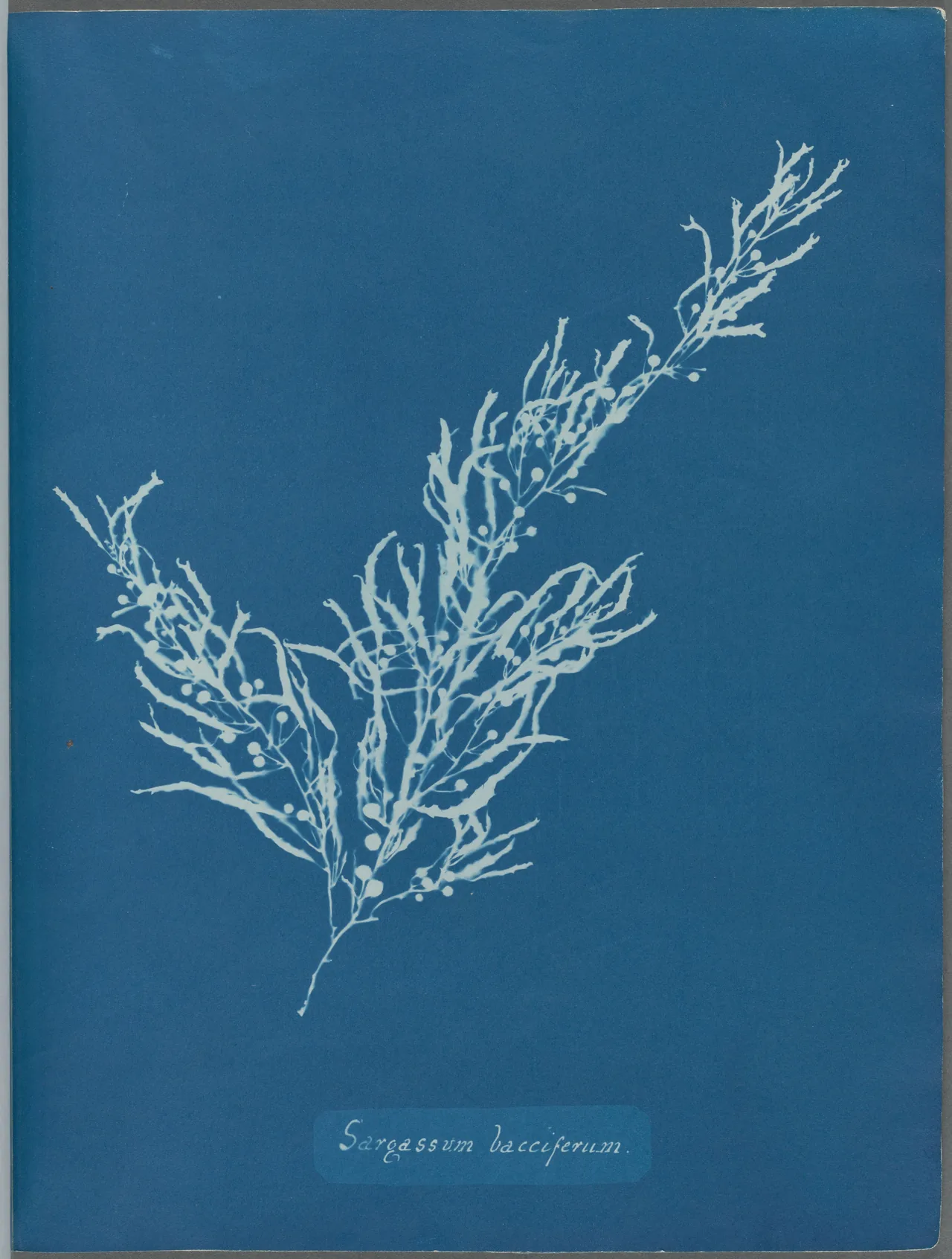
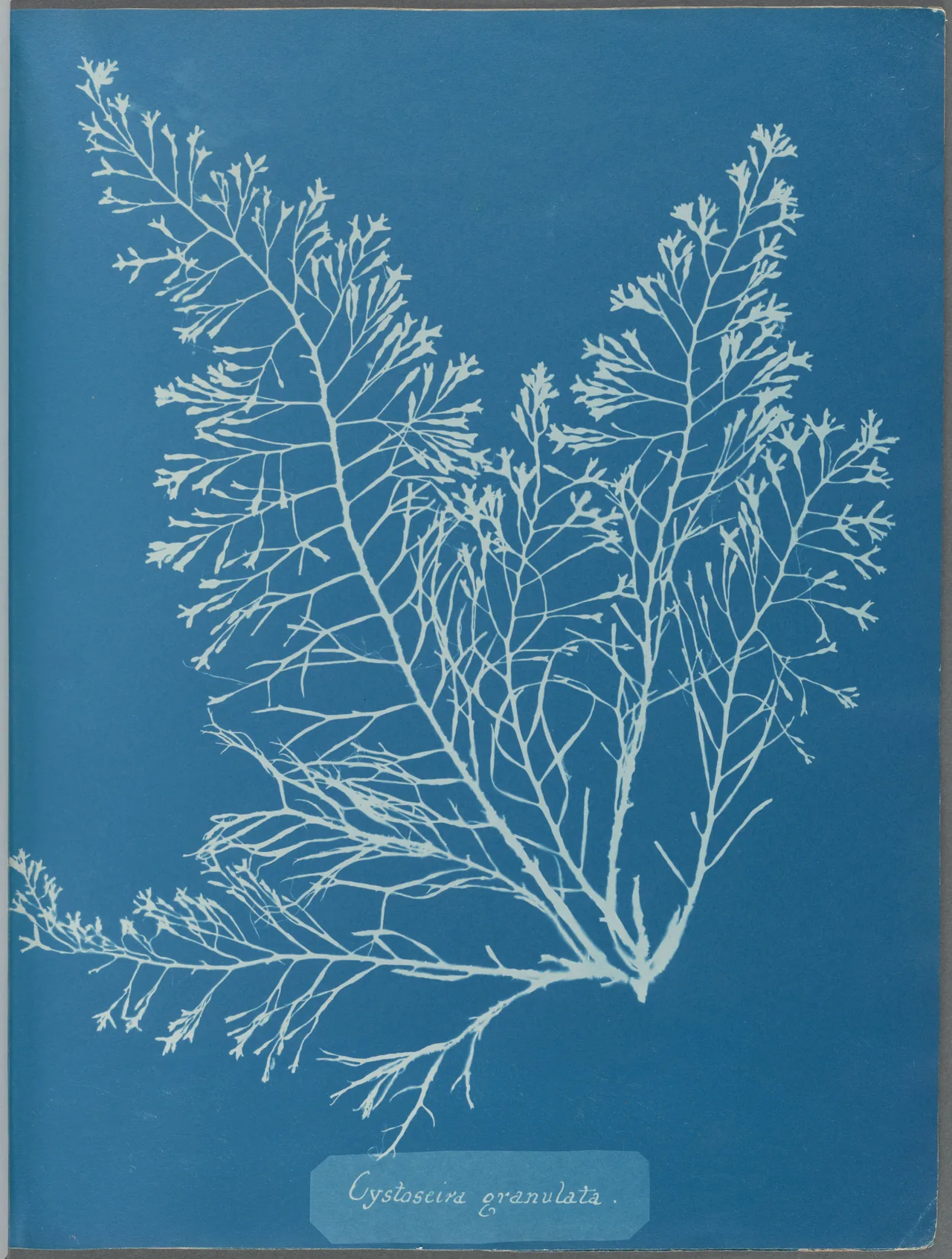
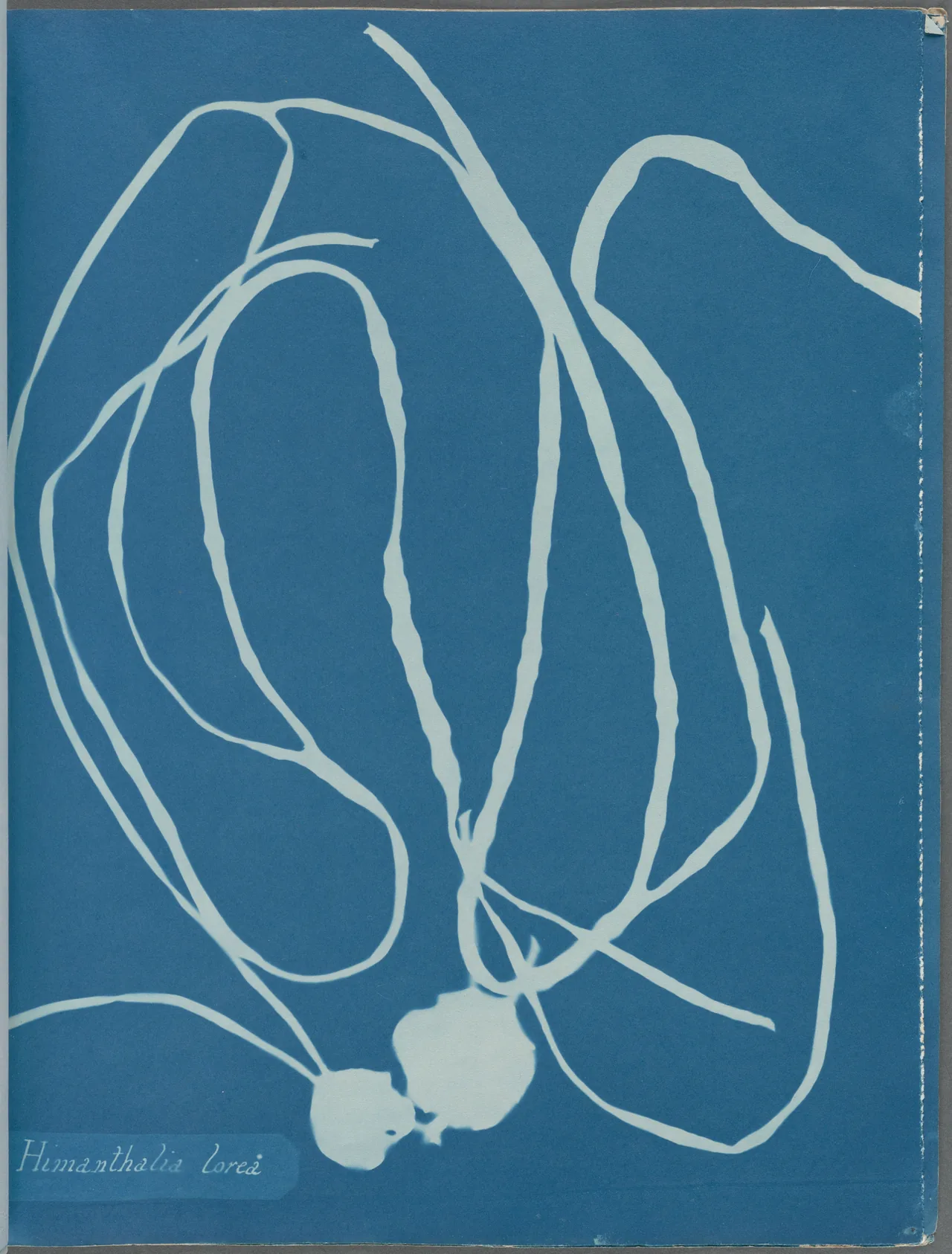
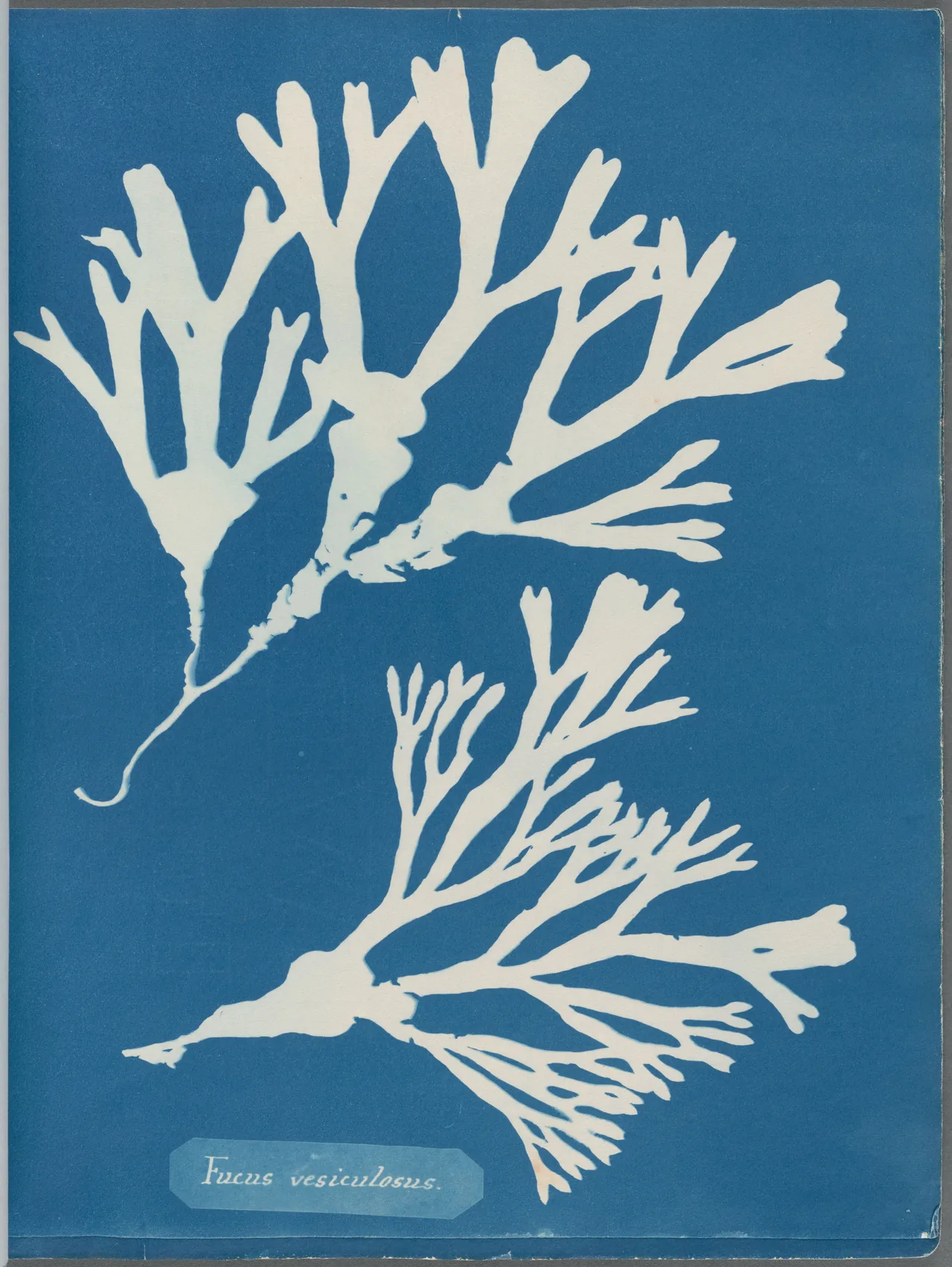
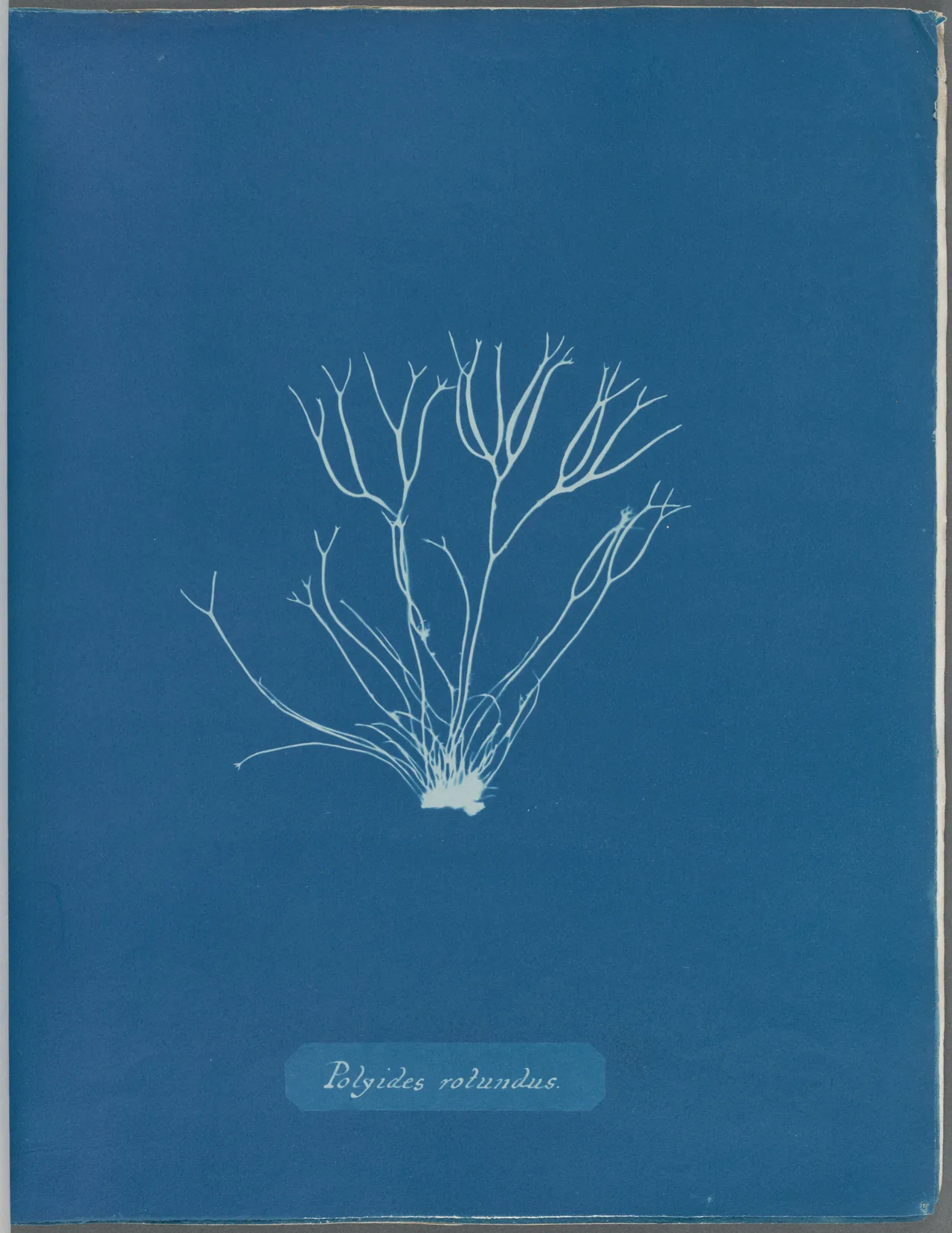
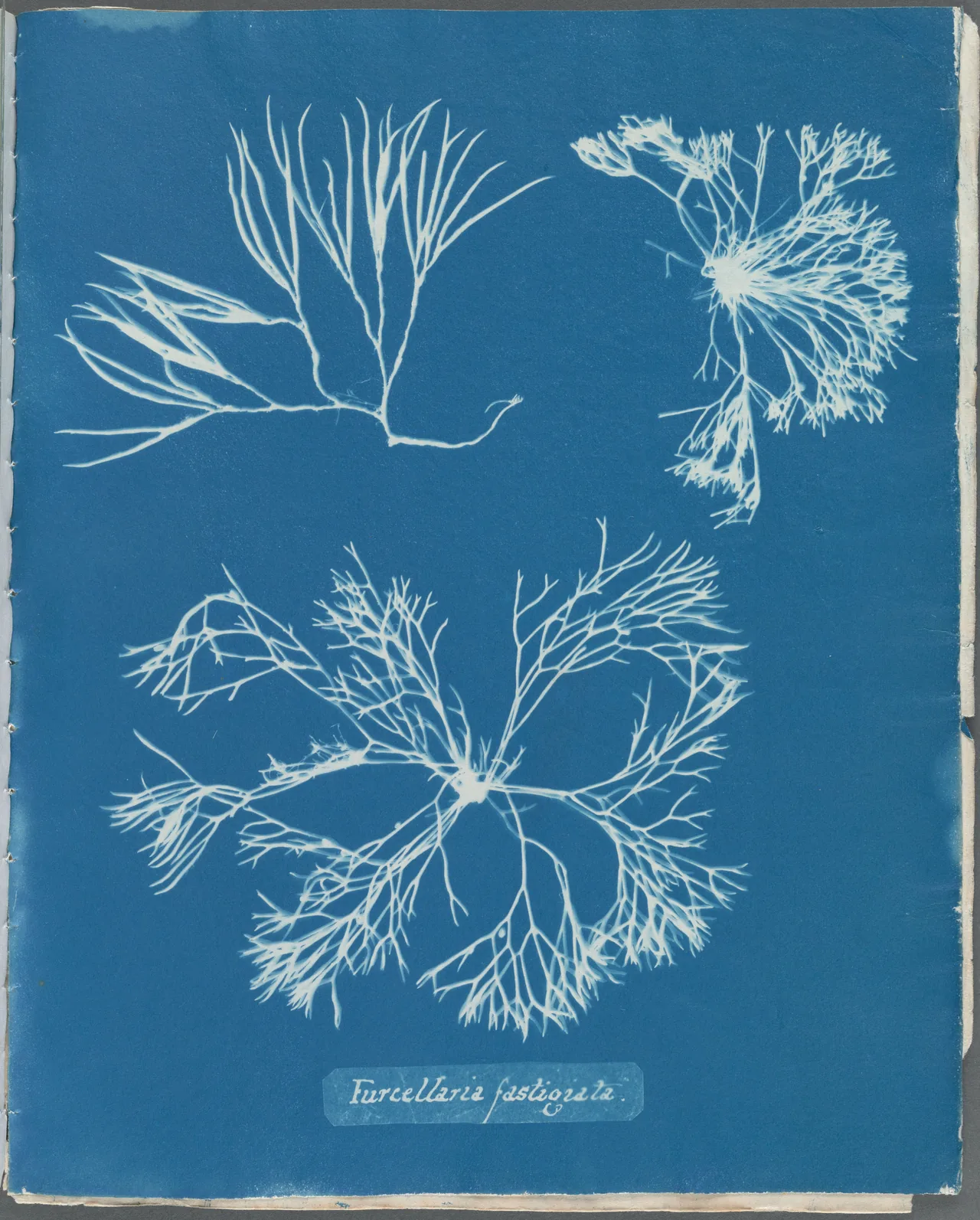
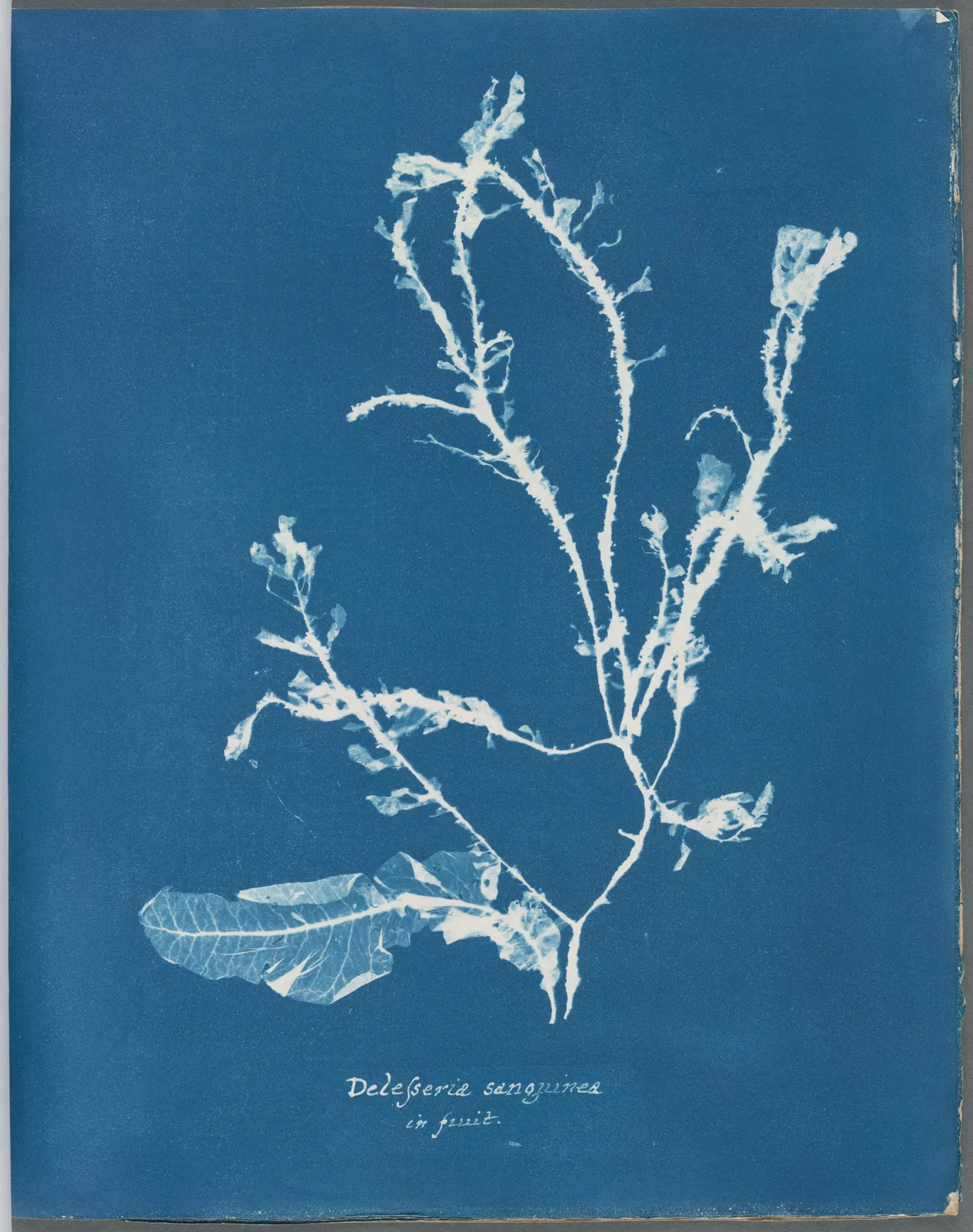
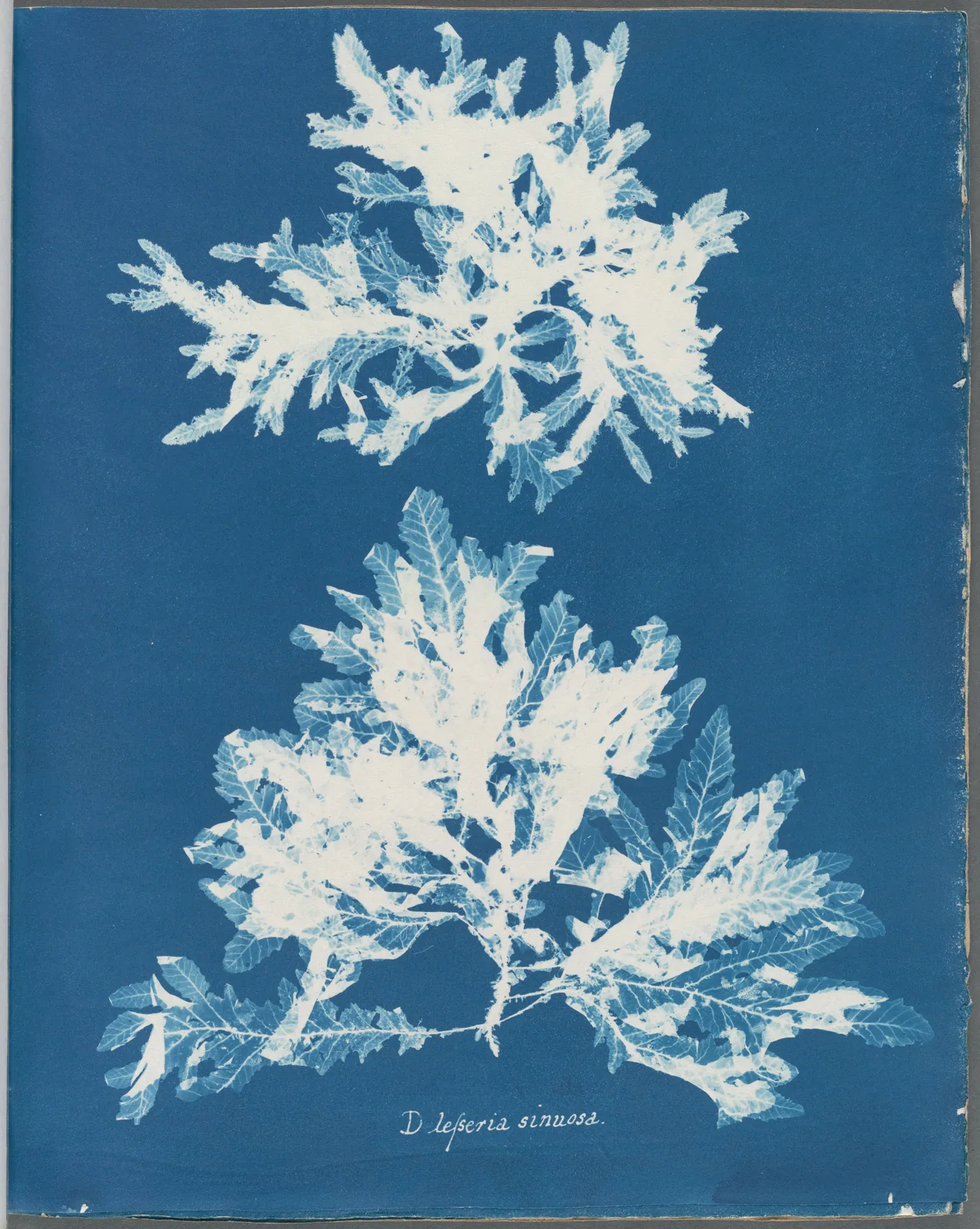
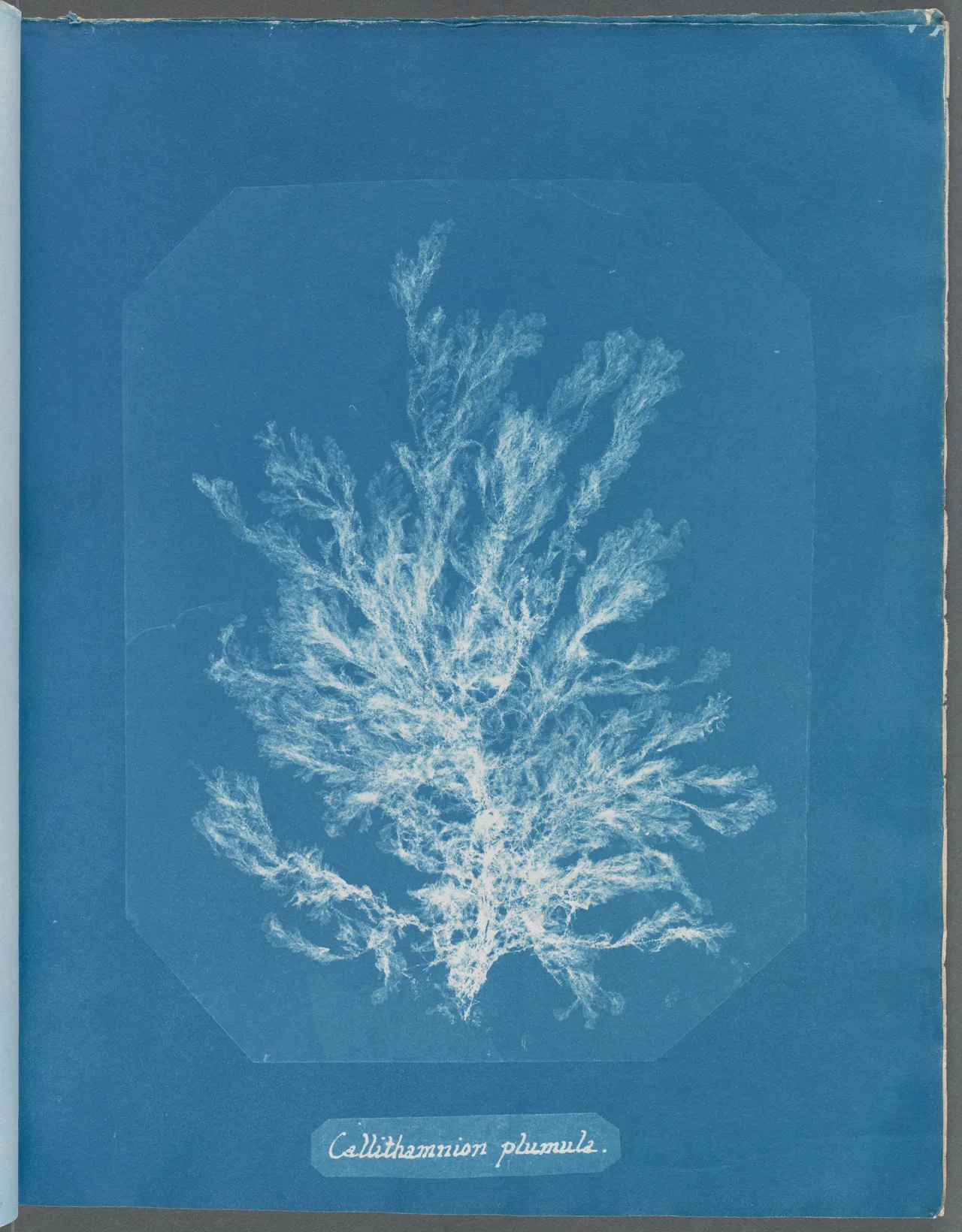
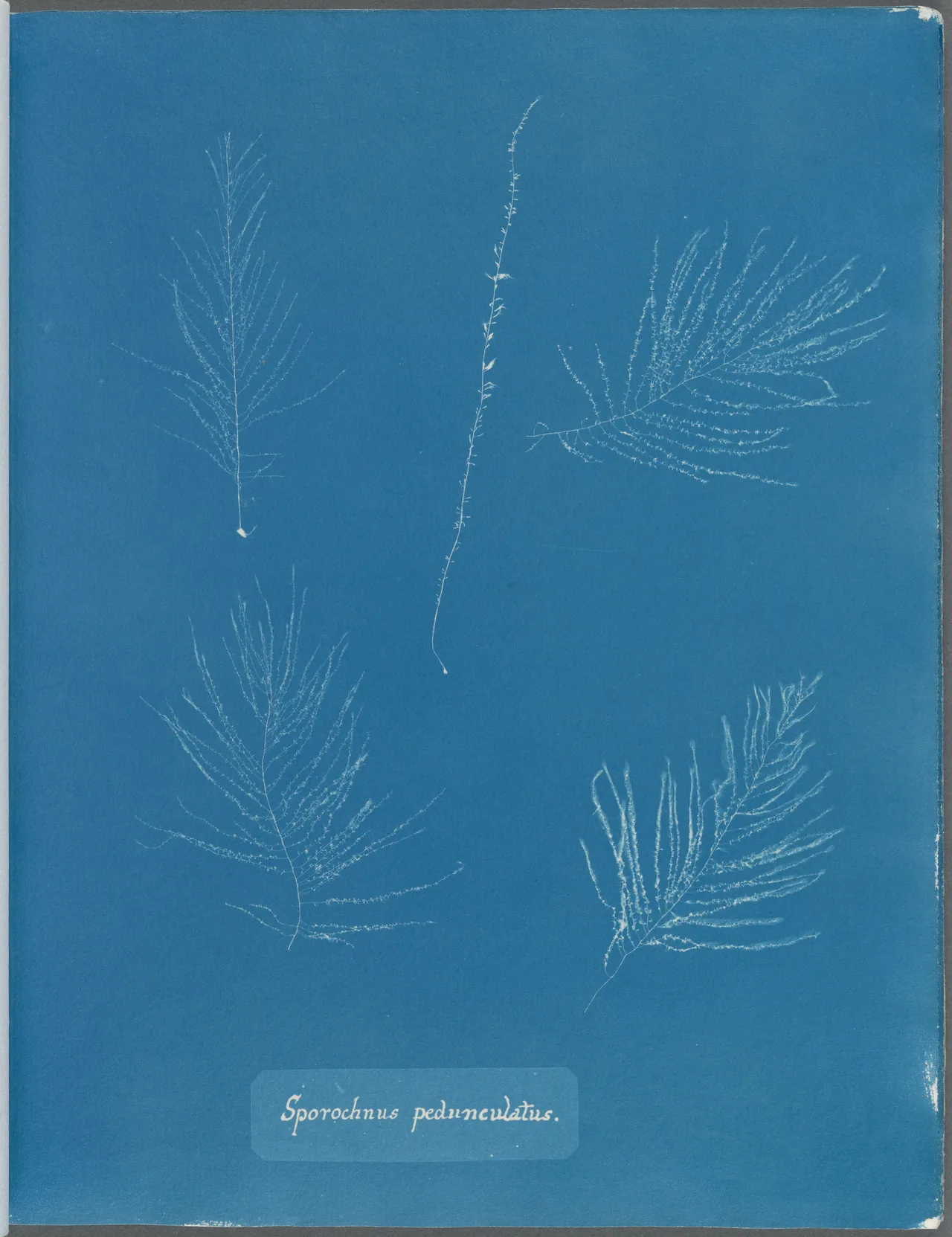
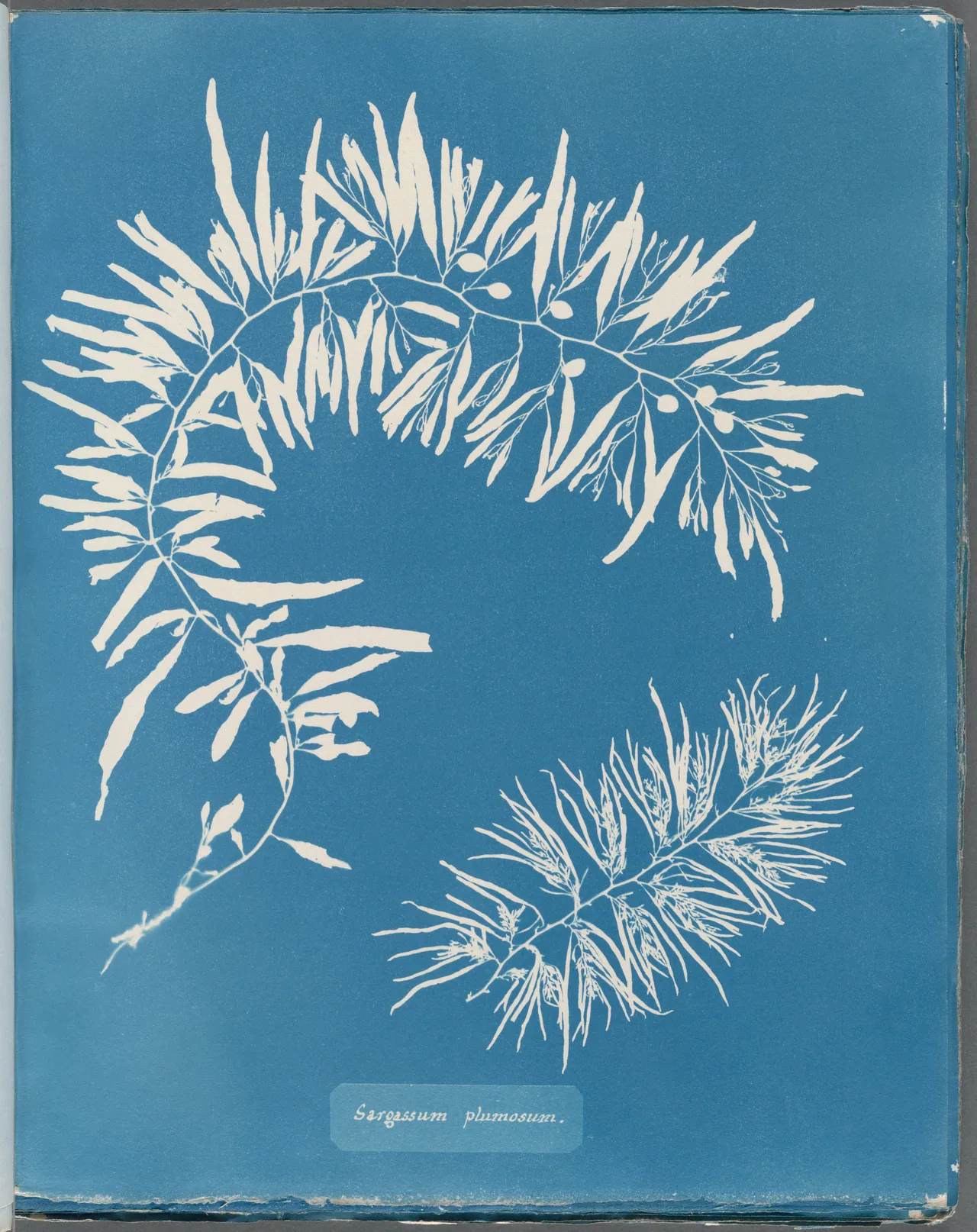
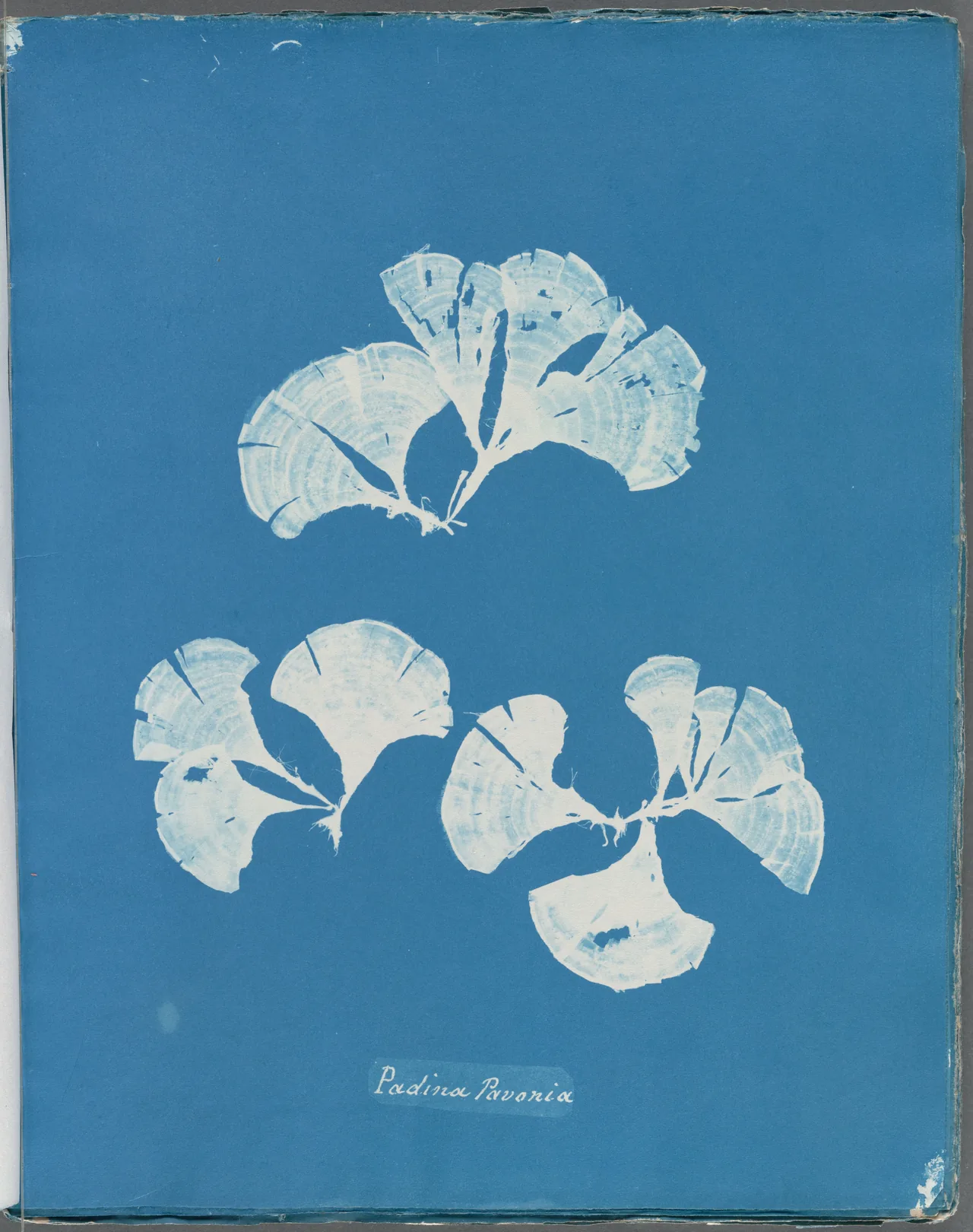
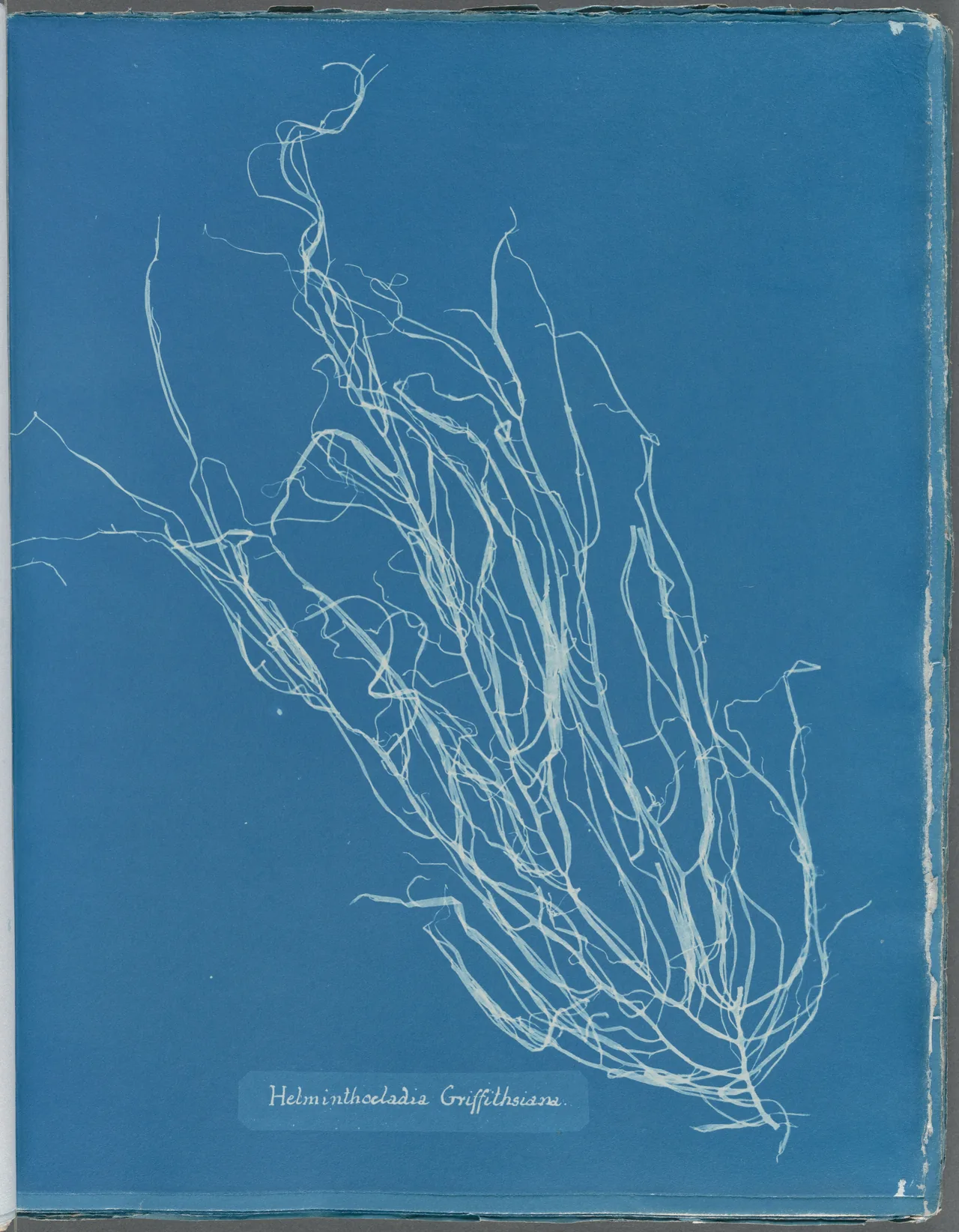
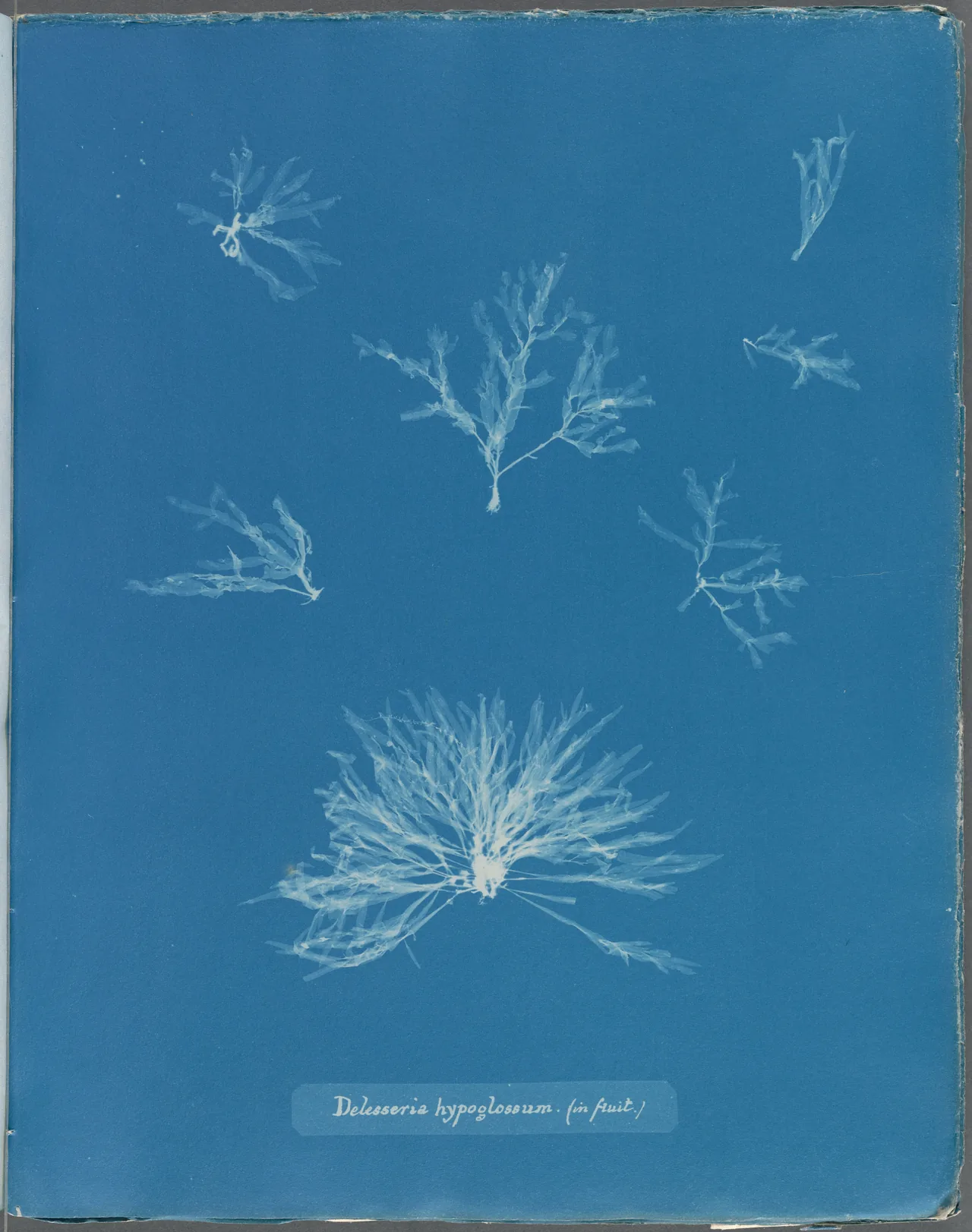
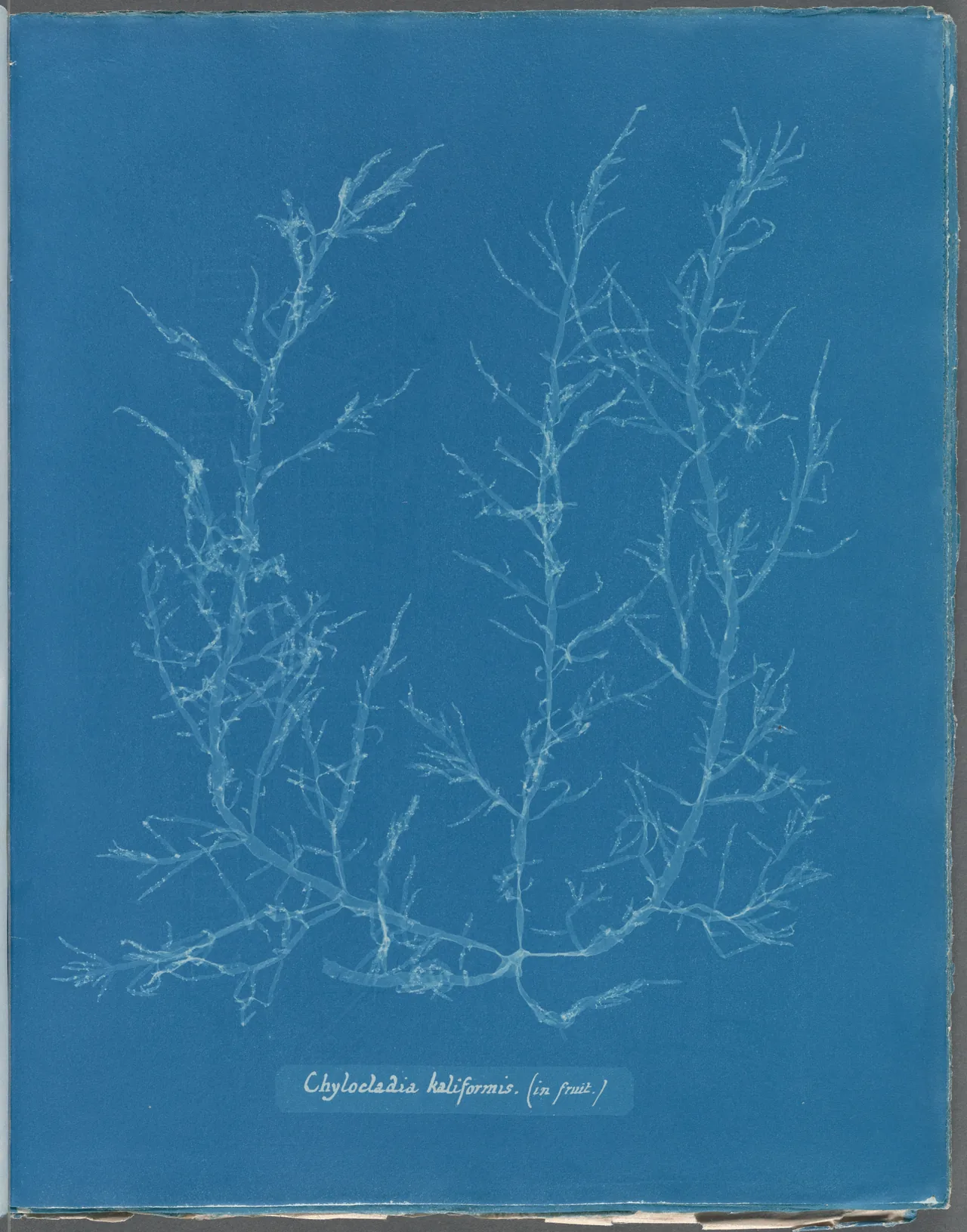
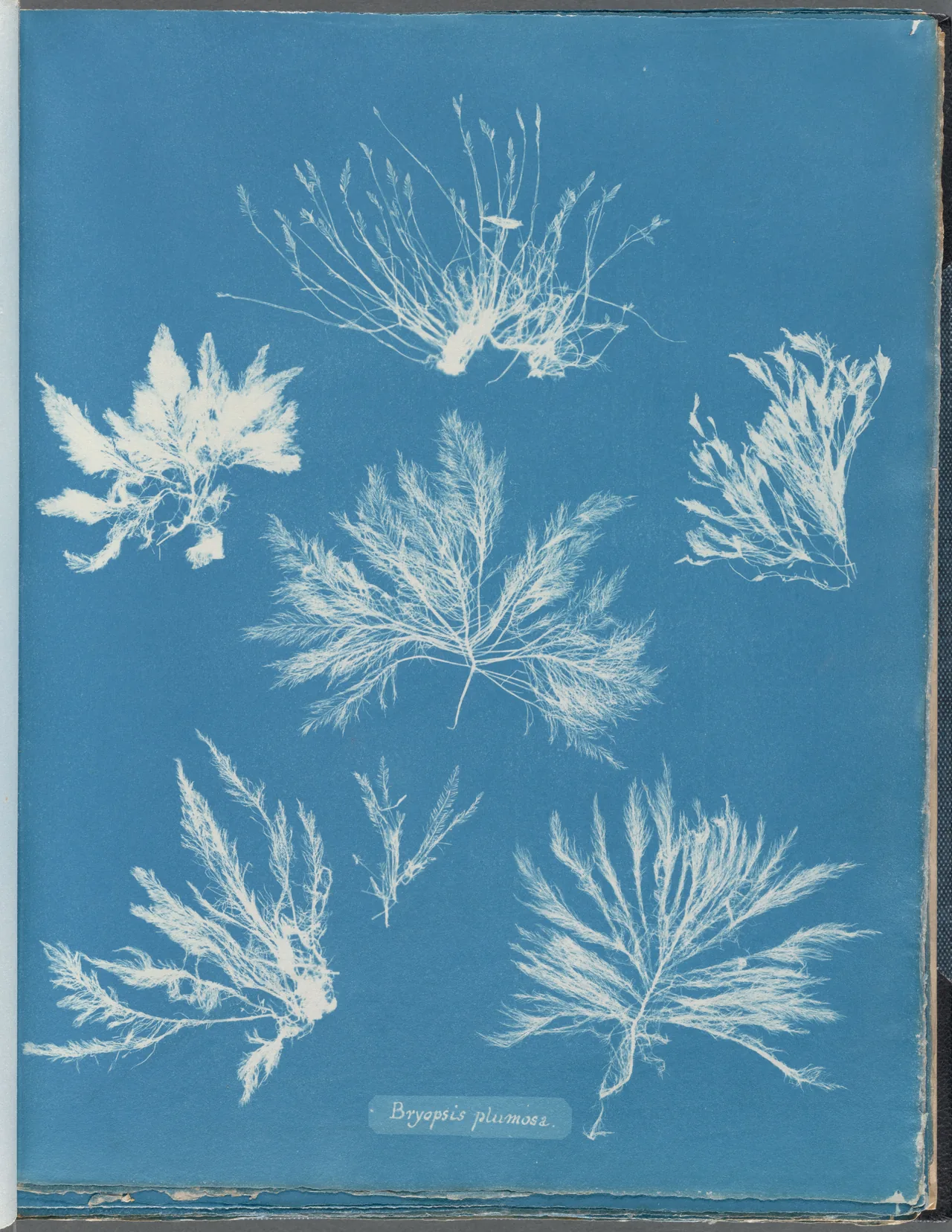
What she did next can be read in every surviving sheet. She brushed two iron-salt solutions onto a sheet of paper and left it to dry in the dark. On the dry sheet she placed the pressed specimen, as flat as possible, and put both in the sun. Where light reached the paper, the salts changed; beneath the plant, the paper remained as it was. Then the sheet went into water. The unexposed salts washed out, the exposed areas turned Prussian blue, and the alga stood pale against the blue, a negative in the literal sense. Where a branch was translucent or did not lie quite flat, some light passed through or underneath, and the sharp outline gave way to gradations of blue, those soft, almost tangible traces found in many of the plates. Finally, she added the species name in Harvey’s nomenclature, so that her book could stand beside his.
The first instalment went to the Royal Society in October 1843, inscribed in her own hand: “For the Royal Society, Presented by Mrs Atkins”. Further instalments followed until 1853, eventually amounting to more than four hundred plates, with 411 in the copies held by the Natural History Museum. There was no print run in the usual sense. Atkins exposed, washed and dried every plate of every copy individually, with different light, a different coating and usually a different plant specimen; those who received the parts had them bound as they saw fit, added to them or rearranged them. As a result, no two of the roughly twenty known copies are alike.
Specimen and image
Atkins wanted to solve a botanical problem, and before making each sheet she had to decide: which specimen, how to spread it out, where to place it on the page. Some algae stand alone, almost austere against the blue. Others form groups, overlap or grow into the space from the edge. The name beneath the impression identifies the species; the arrangement turns the impression into an image.
Cyanotype preserved outlines, branching and often astonishingly fine details. It did not reproduce the colour or the three-dimensional form of living algae, so botanical drawing remained in use. Atkins had seen what task the new process could perform and, from that one task, developed the form of an entire book.
After the algae, she continued working with her childhood friend Anne Dixon: Cyanotypes of British and Foreign Ferns in 1853, Cyanotypes of British and Foreign Flowering Plants and Ferns in 1854. The ferns needed larger sheets, and on those larger sheets the two women arranged the plants more freely than a catalogue would have required.
Anna Atkins died in 1871. Her books are now held in London, New York and Los Angeles, and in each one the algae sit a little differently against the blue.
Selected plates
Thirty cyanotypes
These images come from the copy held by the New York Public Library. They are shown in full, without reduced contrast. Click a plate to open it at a higher resolution.